
Pea Gravel Calculator: Yards, Tons, Bags and Cost
A pea gravel order can look straightforward until you compare the measurements with the product label. Your garden bed is measured in square feet, the bulk supplier quotes tons, and the bags list cubic feet. Choosing the wrong depth or conversion can leave you short, increase delivery costs, or put more loose stone in the space than you intended.
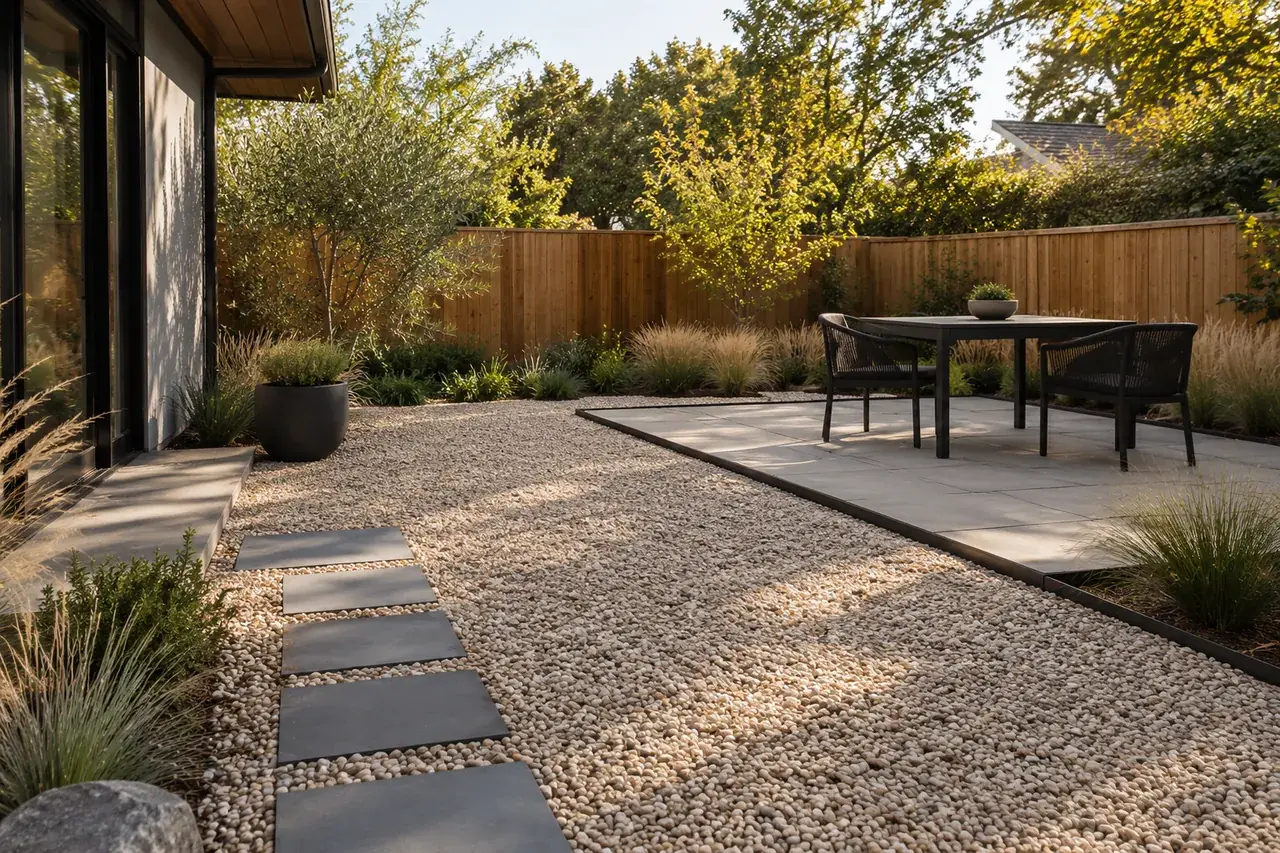
Use this pea gravel calculator to estimate volume, weight and bag quantities from your dimensions or known area. Enter the selected layer depth, your supplier’s bulk density and the actual package size. Add local prices and delivery charges to compare a bagged purchase with a bulk order.
This guide explains the calculations and the buying decisions behind them. You will find worked examples, coverage tables, pea gravel landscaping considerations, driveway trade-offs and a supplier checklist. The aim is to order an appropriate quantity of a suitable product, with the assumptions clearly recorded.
Build your estimate
US + metric · No signup neededMeasure. Check. Plan.
Measure your project
Record dimensions and separate layers before estimating.
Use the right basis
Check product specifications, units and supplier quote inclusions.
Keep your project record
Save your inputs and estimate with the print control.
On this page
What Is Pea Gravel?
Pea gravel generally refers to small, rounded landscaping stones. The name describes their appearance rather than establishing one nationwide specification for stone size, color, grading or weight.
For example, one US supplier markets a 3/8-inch natural pea gravel product. That describes its particular listing; check the size and grading of the material available from your own supplier.
Check the Product, Not Just the Name
Ask to see a sample or clear photograph before ordering a large quantity. Confirm whether the product is rounded, washed and screened, and whether the delivered material can vary in color.
Record the supplier’s exact product name with your estimate. Two products sold as pea gravel may have different package yields, bulk densities and purchasing terms.
Pea Gravel vs. Crushed Stone
Rounded pea gravel and angular crushed stone are not interchangeable in every application. Appearance, particle shape and grading matter when choosing between a decorative surface and a material intended to provide a stable base.
FHWA’s archived granular-base guidance identifies angular particles and suitable grading as important to base stability. It supports checking the project specification rather than choosing a structural material by its decorative appearance alone.
How to Use the Pea Gravel Calculator
Start with the size of the area receiving pea gravel. Exclude spaces that will remain uncovered, and use the thickness of this material layer rather than the total excavation depth.
- Choose the measurement method. Enter dimensions, a known area or a known volume.
- Enter the layer depth. Keep inches, feet and metric units clearly distinguished.
- Check the base volume. This is the geometric quantity before an allowance.
- Enter supplier density when estimating weight. Confirm what material and condition it describes.
- Add an optional ordering allowance. Keep its purpose and percentage visible.
- Enter package size and purchasing details. Use actual bag information, unit prices and delivery charges.
Volume comes from the measurements. Weight requires density, bag count requires package information, and purchasing cost requires a quote.
Estimating Separate Areas
Calculate non-overlapping sections individually, then add their volumes. This is useful for a winding border, an L-shaped bed or several areas with different depths.
Combine sections only when you intend to order the same material. Keep a crushed-stone base and a pea gravel surface as separate estimates. For another specified loose aggregate, use the gravel calculator with that product’s own density and package data.
How Much Pea Gravel Do I Need?
For a rectangular area measured in feet, with depth measured in inches:
Cubic yards = length (ft) × width (ft) × depth (in) ÷ 324
The calculation converts inches to feet and cubic feet to cubic yards. NIST documents that 1 cubic yard equals 27 cubic feet.
If You Already Know the Area
Use the measured square footage directly:
Cubic yards = area (sq ft) × depth (in) ÷ 324
For cubic feet, divide by 12 instead:
Cubic feet = area (sq ft) × depth (in) ÷ 12
Square footage alone does not establish a quantity. The same space needs twice the volume when the selected layer is twice as deep.
Circular and Irregular Spaces
For a circular area, calculate the area from its diameter:
Area = π × (diameter ÷ 2)²
Multiply that area by the depth in compatible units. For irregular shapes, divide the space into smaller measurable sections and avoid counting shared areas twice.
Small Garden Border Example: Buying Pea Gravel in Bags
Suppose a rectangular border measures 12 feet by 4 feet. At an illustrative depth of 2 inches, the calculation is:
| Step | Calculation | Result |
|---|---|---|
| Area | 12 × 4 | 48 sq ft |
| Depth in feet | 2 ÷ 12 | 0.167 ft |
| Base volume | 48 × 2 ÷ 12 | 8 cu ft |
| Cubic yards | 8 ÷ 27 | 0.296 cu yd |
If the selected product contains 0.5 cubic feet per bag, the base requirement is 16 bags. Home Depot lists a Vigoro pea gravel product in that package volume, providing a real example of a volume-labeled bag. Check your own product label before using the same figure.
Adding a Chosen Allowance
If you choose a 10% allowance, the adjusted volume becomes:
8 × 1.10 = 8.8 cubic feet
At 0.5 cubic feet per bag, that equals 17.6 bags, rounded up to 18 whole bags. The 10% is an example, not a required allowance for every project.
Comparing Two Depth Choices
The same border produces different quantities at different depths:
| Illustrative depth | Base volume | Bags at 0.5 cu ft each |
|---|---|---|
| 2 inches | 8 cu ft | 16 |
| 3 inches | 12 cu ft | 24 |
Changing the depth from 2 to 3 inches increases the volume by 50%. Choose the depth from the intended application and product guidance, then use the calculator to compare the consequences.
Larger Area Example: Planning a Bulk Order
Suppose an area measures 18 feet by 12 feet, with an illustrative 3-inch layer.
| Measurement or result | Value |
|---|---|
| Area | 216 sq ft |
| Depth | 0.25 ft |
| Base volume | 54 cu ft |
| Base cubic yards | 2 cu yd |
| Bags at 0.5 cu ft each | 108 |
A chosen 10% allowance would increase the estimate to 59.4 cubic feet, or 2.2 cubic yards. With the same bag size, the adjusted requirement would be 119 whole bags.
Keep the Calculated Quantity and Final Order Separate
A supplier may sell bulk material in increments or apply a minimum order. Ask what purchasable quantity corresponds to your calculated requirement.
Record both figures. An estimate of 2.2 cubic yards and an order rounded to a larger available increment should remain distinguishable.
How Much Does Pea Gravel Weigh?
Pea gravel weight depends on the product’s bulk density. This describes the weight of a volume containing stones and the spaces between them.
Use the supplier’s value for the material and condition being estimated. A density describing solid rock alone is not the same as the bulk density of loose aggregate.
Convert Cubic Yards to US Short Tons
When density is supplied in pounds per cubic yard:
Pounds = cubic yards × density (lb/cu yd)
US short tons = pounds ÷ 2,000
A metric tonne is a different unit. Keep the ton standard explicit when comparing your estimate with a supplier’s quote.
A Product-Specific Weight Example
The US supplier listing for 3/8-inch natural pea gravel gives an approximate weight of 2,800 pounds per cubic yard. It also notes that moisture and compaction affect weight; this value should not be treated as a universal pea gravel specification.
Using that listed value for the earlier 2-cubic-yard example:
| Calculation | Result |
|---|---|
| 2 × 2,800 | 5,600 lb |
| 5,600 ÷ 2,000 | 2.8 US short tons |
If your supplier gives a different density, use it instead. The geometric volume remains 2 cubic yards, while the estimated weight changes. For an existing supplier quote expressed in another mass or volume unit, use the cubic yards to tons converter.
How Many Bags of Pea Gravel Do I Need?
Read the package label before calculating. A bag may state volume, weight or coverage at a particular depth.
These are different ways of describing a quantity. Do not assume that every pea gravel bag has the same yield.
Bags Labeled by Volume
Bag count = required volume ÷ volume per bag, rounded up
For example, 12 cubic feet divided by a verified 0.5-cubic-foot package equals 24 bags.
Apply any chosen allowance before rounding the final bag count. Keep intermediate calculations unrounded.
Bags Labeled by Weight
Bag count = required weight ÷ weight per bag, rounded up
To obtain required weight from project dimensions, first calculate volume and apply the matching product density.
A bag weighing 50 pounds is not automatically a 0.5-cubic-foot bag. Use the weight calculation only when the density and package information describe the material being purchased.
Bags Labeled by Coverage
Bag count = project area ÷ coverage per bag, rounded up
Use this method when the product’s stated coverage depth matches your selected layer depth. A coverage statement without its depth is incomplete for estimating purposes.
If the intended depth differs, calculate from a verified package volume or ask the manufacturer for suitable coverage information.
Pea Gravel Coverage by Depth
For a known volume:
Coverage (sq ft) = cubic yards × 324 ÷ depth (in)
The table below shows geometric coverage for one cubic yard. Its depths illustrate the calculation; they are not installation specifications.
| Illustrative depth | Coverage from 1 cu yd |
|---|---|
| 1 inch | 324 sq ft |
| 2 inches | 162 sq ft |
| 3 inches | 108 sq ft |
| 4 inches | 81 sq ft |
These results exclude handling losses and any project-specific adjustment.
Coverage From a 0.5-Cubic-Foot Bag
A package explicitly containing 0.5 cubic feet has the following calculated coverage:
| Illustrative depth | Geometric coverage |
|---|---|
| 1 inch | 6 sq ft |
| 2 inches | 3 sq ft |
| 3 inches | 2 sq ft |
| 4 inches | 1.5 sq ft |
Manufacturer coverage figures may use their own rounding or assumptions. Check those details before substituting a calculated value for the product’s instructions.
Coverage From One US Short Ton
Convert weight to volume using the selected density, then divide by depth.
With the earlier 2,800 lb/cu yd assumption, one 2,000-pound US short ton represents approximately 0.714 cubic yards. At an illustrative depth of 3 inches, its geometric coverage is approximately 77.14 square feet.
Pea Gravel Cost: Compare Complete Quotes
Published price examples: compare the same product and unit
| Location / source | Listed product | USD / sale unit | Extra charges and limits |
|---|---|---|---|
| Mansfield, OH · Petty Farms Effective January 1, 2026 | #8 river gravel, pea sized | $31.25 / ton | 7% seller-listed tax unless exempt; delivery not established |
| Bulverde, TX · Blanco Road Mulch 2026 price list; exact effective date not stated | Texas Blend color pea gravel | $130.00 / yard | Tax and destination freight not resolved |
Use your supplier’s current written quote in the calculator. A price per ton cannot be compared directly with a price per cubic yard without a matching bulk density and ton standard. Transport, minimums, tax and installation can change the total substantially.
Pea gravel cost depends on the product, order quantity, purchasing unit and delivery arrangement. Use a quote for your location rather than treating a broad online price range as your project budget.
Separate material costs from delivery, preparation and installation. This makes quotes easier to compare and reveals what each supplier or contractor has included.
Bulk Material Cost
Bulk material cost = ordered quantity × price per matching unit
Multiply cubic yards by a price per cubic yard, or US short tons by a price per US short ton.
If the supplier rounds the order, calculate the purchasing cost from that final order quantity. Keep the original requirement visible beside it.
Bagged Material Cost
Bagged material cost = whole bags purchased × price per bag
Add any bag-delivery charge separately. For pickup, consider the practical transport and handling arrangements rather than comparing only the displayed bag price.
Example: Bags vs. Bulk
Use the earlier 2-cubic-yard requirement, without an allowance. Suppose the quotes are $70 per cubic yard plus $90 bulk delivery, or $5 per 0.5-cubic-foot bag with no bag-delivery charge.
These are hypothetical prices used to demonstrate the calculation, not current national market prices.
| Purchasing option | Material | Delivery | Total before tax |
|---|---|---|---|
| Bulk: 2 cu yd | $140 | $90 | $230 |
| Bags: 108 packages | $540 | $0 | $540 |
In this example, bulk has the lower material-and-delivery total. A different quantity, delivery charge, minimum order or product price can change the comparison.
Costs Outside the Material Estimate
Check whether the project also requires:
- Removal and disposal of existing material.
- Excavation, grading or base repairs.
- Separate base aggregate.
- Edging and other specified materials.
- Equipment hire and installation labor.
- Taxes or additional supplier fees.
A material estimate does not automatically represent an installed project price. Ask for an itemized scope before comparing contractor totals.
Compare the same pea-gravel product
Color, source, washing, stone size and retail packaging can make two pea-gravel prices different before delivery. Use the published supplier examples and delivery worksheet to keep the product, unit and transport separate. The pea gravel patio planner covers edging, access and furniture where the material will be used.
Buying Pea Gravel in Bags vs. Bulk
Choose a purchasing method that suits the quantity, site access and handling work.
| Consideration | Bags | Bulk |
|---|---|---|
| Quantity | Whole packages | Supplier’s available order increments |
| Product identification | Check each package label | Confirm the product named on the quote |
| Delivery | Pickup or bag delivery | Truck access and unloading arrangement |
| Moving material | Carry and open packages | Move loose material from the unloading point |
| Excess | Check unopened-bag return terms | Plan for surplus delivered material |
When Bags Are Worth Comparing
Bags can suit a small border or a project completed in stages. Calculate the full package count so a modest-looking unit price does not hide a large total.
Check whether the same product will remain available if you intend to buy it across several visits.
When Bulk Is Worth Comparing
For a larger quantity, request a bulk quote alongside the bagged total. Confirm the minimum order, delivery fee and unloading location.
Ask how the material will be moved from the delivery point to the project. A lower supply price may still involve substantial handling work.
Pea Gravel Landscaping: Match the Material to the Task
Pea gravel landscaping involves more than selecting a stone color. Consider who will use the area, how the surface should behave and how the gravel will be contained.
The following checks help separate decorative decisions from requirements for a walking surface, drainage system or structural layer.
| Intended use | Questions to resolve |
|---|---|
| Decorative border | What size, color and depth suit the design? How will the edges contain it? |
| Garden bed | Does the planting plan suit a stone surface? Can irrigation and maintenance remain accessible? |
| Walking path | Is the completed surface sufficiently firm and stable for its users? |
| Patio surface | How will furniture, circulation and maintenance be handled? |
| Drainage installation | Does the specified aggregate match the drainage design? |
| Driveway or structural base | Does the product meet the required grading and performance specification? |
Decorative Beds and Borders
Measure around planted areas and other features that will remain uncovered. For a winding border, use several smaller sections instead of a large rectangle that includes empty space.
Check how you will access plants and irrigation after the stone is placed. Keep future maintenance in mind when deciding where pea gravel belongs.
Walking Paths and Mobility
A rounded decorative stone should not automatically be treated as a firm walking surface. The US Access Board’s outdoor guidance explains the importance of firmness and stability and identifies broken-face rock and appropriately graded mixtures as generally more stable alternatives to rounded, single-size material.
For a route used by wheelchairs, walkers, strollers or frequent wheeled traffic, assess the completed surface. Product appearance alone does not establish its usability.
Patio Surfaces
For a pea gravel patio, consider furniture placement, circulation, containment and the planned supporting layers before ordering the surface material.
Estimate pea gravel separately from any specified base. A patio’s total excavation depth should not be entered as the pea gravel layer depth unless the design actually calls for that.
Drainage Applications
A decorative product listing does not establish that the material matches a drainage specification. Confirm the required aggregate size and grading, along with the rest of the system design.
Calculate only the volume actually occupied by that material. Pipes, structures and separately specified layers may affect the quantity. For seating, edging, access, and installation decisions, continue to the pea gravel patio guide.
Is Pea Gravel Suitable for a Driveway?
Treat a driveway as a load-bearing project rather than a decorative bed. Confirm the surface material, supporting layers, drainage and maintenance requirements before placing an order.
Pea gravel’s rounded appearance does not establish that it provides the stability required for your driveway. A supplier or installer should identify the appropriate aggregate and layer arrangement for the intended use.
Keep Driveway Layers Separate
Calculate each specified layer using its own depth and material properties. Do not apply the pea gravel density to a different base aggregate.
For resurfacing, establish what remains usable beneath the new surface. Adding loose decorative stone does not explain or resolve an existing base problem. Review the gravel driveway guide before treating decorative stone as a load-bearing surface.
Edging and Gravel Migration
Plan containment when deciding the layout. Supplier guidance for the reviewed natural pea gravel product identifies edging as a way to reduce movement of loose decorative stone into adjacent areas.
Check edges at lawns, paving and access points. Choose an arrangement that suits the site and remains practical to maintain.
Replenishing Existing Pea Gravel
Measure the additional thickness required above material that will remain. Estimate deeper low spots separately from areas needing only a light top-up.
Inspect the reason for material loss before ordering. A containment or site problem may need attention alongside replenishment.
Ordering Allowance and Supplier Rounding
An allowance increases the calculated quantity for a stated purpose. It should remain separate from the measured dimensions.
Adjusted volume = base volume × (1 + allowance percentage ÷ 100)
Use a project-specific decision rather than an automatic percentage. Do not count the same adjustment again if a supplier’s ordering conversion already includes it.
Confirm Loose and Finished Conditions
Ask whether the estimate describes loose material, a finished layer or another specified condition. Use a density and ordering conversion that match that basis.
The calculator can show the arithmetic clearly, but it cannot establish the correct construction allowance from dimensions alone.
Pea Gravel Order Checklist
Before purchasing, confirm:
- Product: exact name, stone size, grading and appearance.
- Measurements: dimensions or area, selected depth and units.
- Condition: the volume basis used for the estimate.
- Density: value, unit and supplier source.
- Packages: actual bag volume, weight or depth-specific coverage.
- Allowance: percentage and reason, if applied.
- Order quantity: supplier increments and minimum purchase.
- Price: matching unit, delivery, taxes and other quoted charges.
- Access: unloading location and arrangements for moving the material.
Keep this information with the estimate. It gives the supplier a clear basis for reviewing the quantity.
Frequently Asked Questions
Is “P Gravel” the Same as Pea Gravel?
If you encounter “p gravel” in a search or quotation, confirm what the seller means. Request the full product name, stone size and specification rather than assuming the abbreviation identifies a particular material.
How Deep Should Pea Gravel Be?
Choose the depth from the intended use, product guidance and project specification. A decorative border, walking surface and drainage installation do not automatically share the same requirements.
The calculator estimates the quantity for the depth entered. It does not choose the installation design.
How Many 0.5-Cubic-Foot Bags Equal One Cubic Yard?
One cubic yard contains 27 cubic feet. Dividing by a verified 0.5 cubic feet per package gives 54 bags, before an allowance.
This applies to packages labeled with that volume. Do not substitute a weight-only bag without the necessary product data.
Is Bulk Pea Gravel Always Cheaper?
Compare the complete quotes. Bulk delivery fees and minimum orders can materially affect a small purchase.
Use the same suitable product and the final purchasable quantities when comparing totals.
Will Adding More Depth Make the Surface More Stable?
Extra depth increases the material quantity, but depth alone does not establish stability. Particle shape, grading, supporting layers and the completed surface also matter.
Resolve the required surface performance before using a deeper layer as the solution.
Can I Use Metric Measurements?
Yes. With measurements in meters:
Cubic meters = length × width × depth
For example, a 3-meter by 2-meter area at an illustrative depth of 5 centimeters, or 0.05 meters, requires 0.30 cubic meters before adjustments.
Can I Calculate Coverage From Gravel I Already Have?
Yes. Convert the available quantity to volume, then divide by the selected depth.
If you know only the weight, first use the matching bulk density. Keep that density assumption visible with the coverage result.
How Accurate Is the Pea Gravel Estimate?
The estimate reflects the measurements and product information entered. Uneven ground, uncertain depth and an approximate density can affect how the purchased material compares with the calculation.
Measure separate sections, use the actual package or supplier data, and confirm the final purchasable order before paying.
Understand the estimate and its assumptions
Read the formulas and worked examples on this page alongside the entered values. Geometry estimates space; density converts volume to mass; product yield converts a quantity to packages. An allowance and supplier purchase rounding are separate adjustments.
Use the same material condition and units as the supplier specification. Enter a local quoted price when pricing work. Missing fees remain unresolved, and a material subtotal does not establish an installed project price. Example values illustrate arithmetic and are not local quotes or construction specifications.
Keep the printed input record with your estimate so a supplier or contractor can check the values that produced it.