
Gravel Calculator: Cubic Yards, Tons, Bags and Cost
Ordering gravel starts with a practical problem: the space you measured and the quantity your supplier sells may use different units. A bed measured in square feet still needs a layer depth before you can order cubic yards, tons or bags. An incorrect estimate can mean a second delivery, unfinished areas or excess material left in your yard.
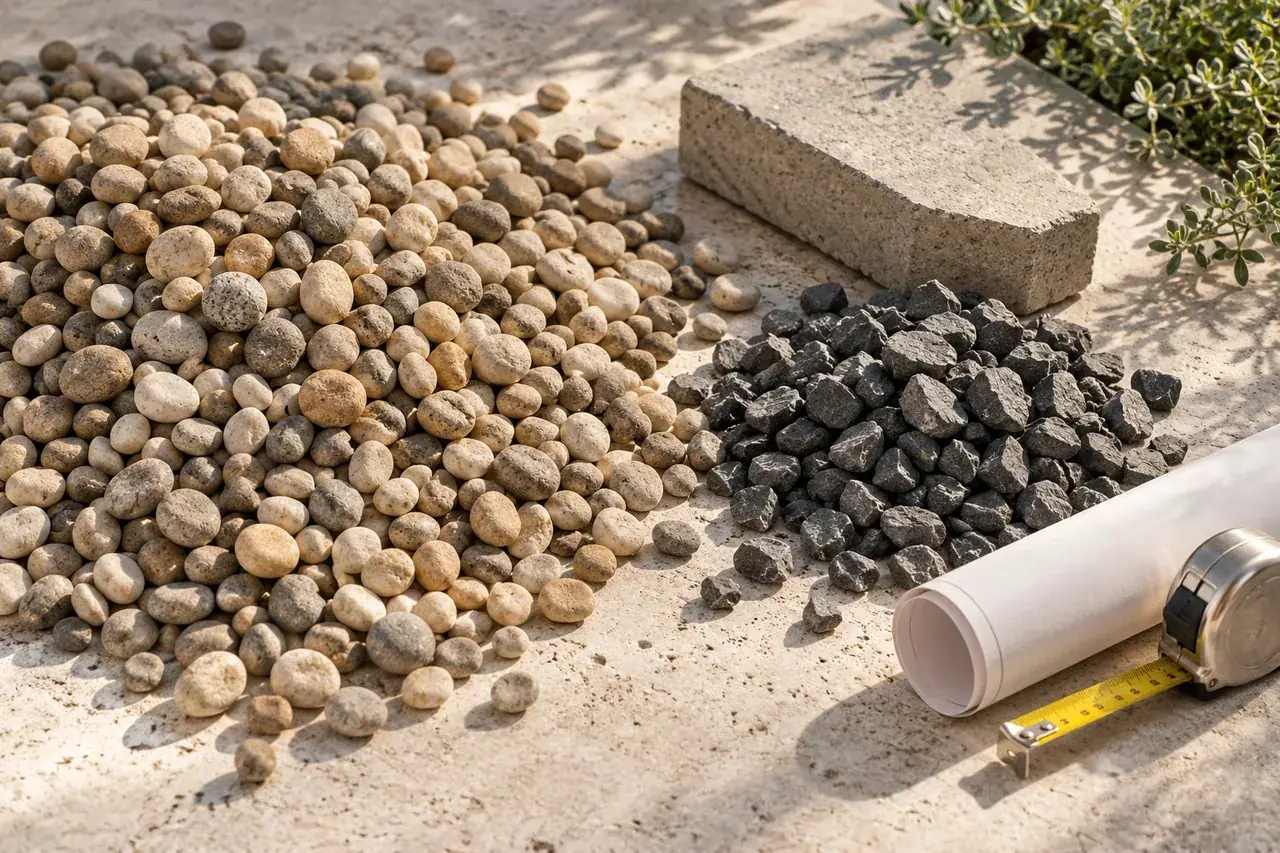
Use this gravel calculator to estimate material from your project dimensions, a known area or an existing volume. Choose settings for gravel, crushed stone or landscape rock, then use your supplier’s density to refine the weight estimate. You can also calculate bag quantities and compare purchasing costs using the prices and delivery charges you enter.
The guide below explains how to measure your project, check the calculations and turn the results into an order. You will find coverage tables, examples for different shapes, guidance on bags of gravel versus bulk deliveries, and a checklist of details to confirm with your supplier.
Build your estimate
US + metric · No signup neededMeasure the space. Set the depth.
Know the quantity before you order.
Measure. Check. Plan.
Measure your project
Record dimensions and separate layers before estimating.
Use the right basis
Check product specifications, units and supplier quote inclusions.
Keep your project record
Save your inputs and estimate with the print control.
On this page
How to Use the Gravel Calculator
Start with the measurements you have, then add the purchasing details you need. Keep the unit beside each input consistent with the measurement you enter.
- Choose your input mode: dimensions, known area or known volume.
- Enter the project size and depth. For a circle, use the diameter; for separate areas, add each section.
- Choose the material and density. Use a supplier value when available and check whether it describes loose or compacted material.
- Review the base quantity. This is the amount calculated before an ordering allowance.
- Enter an optional allowance. Keep this adjustment visible rather than hiding it inside the dimensions.
- Add bag size and prices if needed. Include delivery when comparing purchasing options.
Volume comes from your measurements. Weight depends on the density used, bag count depends on package size, and cost depends on the purchasing details you provide.
How Much Gravel Do I Need?
Figuring gravel quantities begins with the volume of the layer you want to place. For a rectangular area measured in feet, with depth entered in inches, use:
Cubic yards = length (ft) × width (ft) × depth (in) ÷ 324
The divisor combines 12 inches per foot with 27 cubic feet per cubic yard. These relationships are documented in the NIST tables of units of measurement.
Example: A 20-by-10-Foot Gravel Area
Assume a project measures 20 feet long by 10 feet wide, with a 3-inch layer. The depth is an illustrative input; use the depth specified for your project.
| Step | Calculation | Result |
|---|---|---|
| Find the area | 20 × 10 | 200 sq ft |
| Convert the depth | 3 ÷ 12 | 0.25 ft |
| Find the volume | 200 × 0.25 | 50 cu ft |
| Convert to cubic yards | 50 ÷ 27 | 1.852 cu yd |
The base quantity is approximately 1.85 cubic yards before an allowance. Keep the unrounded value during further calculations, then round the final order to an increment your supplier offers.
Already Know the Square Footage?
Multiply your area by the depth rather than entering length and width again:
Cubic yards = area (sq ft) × depth (in) ÷ 324
Square footage alone cannot determine the gravel quantity. Covering the same area at twice the depth requires twice the geometric volume.
Measure Rectangles, Circles and Irregular Areas
Measure only the space receiving gravel. Exclude structures, planted islands and other areas that will remain uncovered.
| Shape | Measurements | Volume calculation |
|---|---|---|
| Rectangle | Length, width and depth | Length × width × depth |
| Circle | Diameter and depth | π × (diameter ÷ 2)² × depth |
| Irregular area | Smaller, non-overlapping sections | Calculate each section, then add the volumes |
| Known area | Area and depth | Area × depth |
Convert measurements into compatible units before multiplying. If separate sections have different depths, calculate their volumes individually.
Circular Area Example
A circle with a 10-foot diameter has an area of approximately 78.54 square feet. At an illustrative depth of 2 inches, it requires approximately 13.09 cubic feet, or 0.485 cubic yards, before an allowance.
L-Shaped Area Example
Split an L-shaped bed into two rectangles that do not overlap. If the rectangles measure 12 × 4 feet and 6 × 3 feet, their combined area is 66 square feet.
At an illustrative depth of 3 inches, the total volume is 16.5 cubic feet, or approximately 0.611 cubic yards. Do not count the shared corner twice. For a separate check of shapes and volume units, use the cubic yard calculator.
Choose the Depth for the Actual Project
For an exterior pipe-and-stone trench, use the French drain planner, which deducts pipe displacement. For a maker-approved shed foundation, the shed pad planner measures the footprint and per-side apron explicitly.
Enter the thickness of the material layer being estimated. If an excavation contains several layers, its total depth is not automatically the depth of the gravel surface layer.
Use the project specification, product guidance or installer’s recommendation to establish the required depth. A quantity calculator works from that decision; it does not determine the correct pavement or drainage design.
Replenishing Existing Gravel
Estimate the additional thickness needed above material that will remain. Where some sections need more topping up than others, measure them separately rather than applying the deepest measurement to the whole area.
If old material must be removed or the base needs repair, account for that work separately from the new surface material. For a multilayer entrance or resurfacing project, use the gravel driveway guide to keep supporting and surface layers separate.
Cubic Yards, Cubic Feet and US Tons
Cubic yards and cubic feet describe volume. Tons describe weight, so converting between yards and tons requires a material density.
| Unit relationship | Value |
|---|---|
| 1 cubic yard | 27 cubic feet |
| 1 cubic foot | 1,728 cubic inches |
| 1 US short ton | 2,000 pounds |
| 1 metric tonne | 1,000 kilograms |
NIST’s measurement tables distinguish these units. Confirm which ton standard applies to your quote before comparing prices or quantities.
Convert Cubic Yards to US Short Tons
When your supplier gives the material weight in pounds per cubic yard:
US short tons = cubic yards × pounds per cubic yard ÷ 2,000
For a density supplied in pounds per cubic foot, multiply the cubic-foot volume by that density, then divide by 2,000. If you already have a quoted volume or load weight, use the cubic yards to tons converter with the matching supplier density.
How Much Does a Yard of Gravel Weigh?
A cubic yard has a fixed volume, but its weight depends on the material’s bulk density. Use the value for the product and condition you intend to purchase rather than treating every gravel type as equally heavy.
The following table demonstrates how different density inputs change the result. These are illustrative inputs, not verified density specifications for particular products.
| Entered bulk density | Weight of 1 cubic yard | US short tons |
|---|---|---|
| 90 lb/cu ft | 2,430 lb | 1.215 |
| 100 lb/cu ft | 2,700 lb | 1.350 |
| 110 lb/cu ft | 2,970 lb | 1.485 |
Which Density Should You Enter?
Ask for the product’s bulk weight per cubic yard or cubic foot and the condition it represents. The value should describe a volume of aggregate with the spaces between its particles, rather than the density of solid rock alone. FHWA’s description of aggregate bulk-density testing distinguishes measurements in loose and compacted conditions.
Bulk density depends on grading, particle shape, moisture and the material condition. Use the value supplied for the exact product you intend to order.
Weight Example Using a Supplier Value
If a supplier specifies 3,000 pounds per cubic yard, the earlier 50-cubic-foot project would weigh approximately 5,556 pounds, or 2.778 US short tons, before an allowance.
That result uses the stated supplier-value assumption. Changing the density changes the weight estimate without changing the project’s geometric volume.
Rock Calculator and Stone Calculator Settings
The volume calculation is the same for a given area and depth, whether you are estimating gravel or another loose landscaping stone. Material selection matters when converting that volume into weight and checking that the product suits the intended use.
Use the gravel calculator with the appropriate material settings instead of applying one weight-per-yard figure to every product.
River Rock Calculator
For river rock, enter the area and intended layer depth, then use the supplier’s bulk density or product-specific coverage information. Check that any coverage figure refers to the stone size and depth you plan to use.
If a bag or supplier listing states coverage at a particular depth, changing that depth changes the area the same quantity can cover.
Crushed Stone Calculator
For crushed stone, confirm the exact product name, grading and whether your measurements represent loose material or a finished compacted layer. Ask the supplier which density or conversion basis matches that condition.
Keep separately specified base and surface materials as separate estimates. A shared project area does not mean both layers have the same depth, density or purchasing requirements.
Landscape Rock Calculator
For decorative beds and borders, exclude uncovered spaces and divide winding shapes into measurable sections. Product size, selected depth and package information should match the material you are actually buying.
For large individual boulders, use the supplier’s piece weights and placement requirements; a loose-fill volume estimate does not describe individual stones reliably.
Aggregate Calculator
Use the aggregate calculator settings for a specified loose material with a known bulk density. Record the supplier’s product description with the result so the estimate remains tied to that material.
Confirm suitability separately. An estimate tells you how much material corresponds to your inputs; it does not establish that the aggregate meets a drainage, concrete or pavement specification. For rounded decorative stone, use the pea gravel calculator to compare its package and bulk-order options. Use the 57 stone and gravel types guide to compare clean stone, graded base, and drainage roles before selecting a product.
How Many Gravel Bags Do I Need?
Start with the actual package information. A gravel bag may be labeled by weight, volume or coverage at a stated depth, and each label requires a different calculation.
For example, QUIKRETE lists its All-Purpose Gravel in 50-pound bags. That weight alone does not establish a universal cubic-foot yield for all gravel products.
Bags Labeled by Volume
Number of bags = required cubic feet ÷ cubic feet per bag, rounded up
For the 50-cubic-foot example, a product explicitly labeled 0.5 cubic feet per bag would require 100 bags before an allowance. Use this calculation only when that volume appears in the actual product information.
Bags Labeled by Weight
Number of bags = required pounds ÷ pounds per bag, rounded up
If the same project’s material has the assumed density of 3,000 pounds per cubic yard, it requires approximately 5,556 pounds. Purchasing that material in 50-pound bags would require 112 bags before an allowance.
The volume-based and weight-based examples use different stated assumptions. A 50-pound bag is not automatically equivalent to a 0.5-cubic-foot bag; use matching product data.
Bags Labeled by Coverage
Divide the project area by the stated coverage per bag when the listed depth matches your intended depth. If the manufacturer provides coverage at several depths, choose the matching value.
Round the final quantity up to a whole bag after applying any chosen allowance. Rounding every intermediate result upward can unnecessarily inflate the order.
Buying Bags of Gravel vs. Bulk Material
Compare the total cost of obtaining the same suitable material in a usable quantity. Bag price and bulk unit price alone do not include every purchasing difference.
| Compare | Bagged purchase | Bulk purchase |
|---|---|---|
| Quantity | Whole bags based on actual package size | Supplier’s available weight or volume increments |
| Material price | Bag count × price per bag | Ordered quantity × matching unit price |
| Transport | Pickup expense or bag-delivery charge | Bulk-delivery charge or suitable pickup arrangement |
| Handling | Moving and opening individual packages | Unloading space and moving loose material |
| Unused material | Check the policy for unopened bags | Confirm how excess delivered material will be handled |
Ask whether a minimum order or delivery charge changes the comparison. For a small project, those charges can matter more than a lower bulk unit price.
How Much Area Will Gravel Cover?
Coverage depends on volume and depth. To calculate the area covered by a known quantity:
Coverage (sq ft) = cubic yards × 324 ÷ depth (in)
Coverage of One Cubic Yard
| Layer depth | Calculated coverage |
|---|---|
| 1 inch | 324 sq ft |
| 2 inches | 162 sq ft |
| 3 inches | 108 sq ft |
| 4 inches | 81 sq ft |
| 6 inches | 54 sq ft |
These are geometric coverage values before losses or compaction adjustments. The depths illustrate the calculation and are not installation recommendations.
Coverage of One Ton
Convert the weight into volume using the material’s bulk density, then calculate coverage. With an assumed density of 3,000 pounds per cubic yard, one 2,000-pound US short ton equals approximately 0.667 cubic yards.
At an illustrative depth of 3 inches, that quantity covers 72 square feet before adjustments. A different density or depth produces a different coverage result.
Estimate Gravel Cost Using Your Supplier’s Price
Published price examples: compare the same product and unit
| Location / source | Listed product | USD / sale unit | Extra charges and limits |
|---|---|---|---|
| Mansfield, OH · Petty Farms Effective January 1, 2026 | #57 limestone | $33.00 / ton | 7% seller-listed tax unless exempt; delivery not established |
| Bulverde, TX · Blanco Road Mulch 2026 price list; exact effective date not stated | 3/4 inch to dust base | $50.00 / yard | Tax and destination freight not resolved |
Use your supplier’s current written quote in the calculator. A price per ton cannot be compared directly with a price per cubic yard without a matching bulk density and ton standard. Transport, minimums, tax and installation can change the total substantially.
The gravel calculator uses the prices you enter. Match the price unit to the quantity unit before multiplying.
| Pricing method | Material-cost calculation |
|---|---|
| Price per cubic yard | Ordered cubic yards × price per cubic yard |
| Price per US short ton | Ordered US short tons × price per US short ton |
| Price per bag | Whole bags purchased × price per bag |
Add delivery, applicable taxes and other quoted charges separately. Installation, excavation, disposal and equipment costs belong in the budget only when you have included them explicitly.
Example: Material Cost Plus Delivery
Suppose your chosen final order is 2 cubic yards, the quoted material price is $65 per cubic yard, and delivery is $80. The material costs $130, giving a total of $210 before tax and any other charges.
These prices demonstrate the calculation; they are not a current national price estimate. Use a quote for your location, material and delivery arrangement.
Ordering Allowance and Compaction
An ordering allowance increases the quantity to cover a stated uncertainty or expected handling loss. Keep the percentage and adjusted quantity visible so you can review the decision.
Adjusted quantity = base quantity × (1 + allowance percentage ÷ 100)
For example, applying a chosen 10% allowance to 50 cubic feet gives 55 cubic feet, or approximately 2.037 cubic yards. The percentage is an example, not a recommendation for every project.
Confirm the Basis for a Compacted Layer
If the specified thickness describes the finished compacted layer, ask the supplier or installer how to translate that requirement into the order. Confirm whether the supplied density describes loose material or the finished condition before combining it with your volume.
Avoid counting the same adjustment twice. If an ordering conversion already accounts for compaction, another compaction allowance can overstate the quantity; any separate handling allowance should have its own stated purpose.
Keep the assumptions with the number
For a rectangle, cubic yards = length(ft) × width(ft) × depth(in) ÷ 324. A US short ton is 2,000 lb. Before converting volume to mass, record product/source, loose or compacted condition, density unit and the supplier document. Write these in the printed estimate notes; a material name alone does not supply density.
For haul fees and locality-qualified prices, see the gravel delivery guide.
Common Gravel Estimating Mistakes
Small input errors can create large differences in the result. Check these points before using an estimate to place an order.
| Mistake | What to check |
|---|---|
| Entering 3 feet instead of 3 inches | Read the depth unit; this error multiplies volume by 12. |
| Using square feet as cubic feet | Include the layer depth when calculating volume. |
| Treating a yard as a ton | Use the density for the specified material. |
| Using the full excavation depth for one layer | Separate layers with different materials or thicknesses. |
| Assuming all bags contain the same volume | Check the actual product label or coverage specification. |
| Adding the same allowance twice | Record what each adjustment covers. |
| Comparing incomplete prices | Include delivery, minimum-order charges and matching quote scopes. |
Confirm These Details Before Ordering
Keep your gravel calculator result with the measurements and material information used to produce it. A supplier can review a clearly documented estimate more easily than an unexplained tonnage.
- Material: exact product name, grading or size, and intended use.
- Measurements: area or dimensions, layer depth and units.
- Condition: loose volume, finished compacted volume or a supplier-confirmed conversion.
- Density: value, unit and source used for the weight estimate.
- Allowance: chosen percentage and what it covers.
- Order unit: cubic yards, US short tons or the specified bag size.
- Purchasing terms: available increments, minimum order, taxes and delivery charges.
- Delivery: access requirements, unloading location and who will move the material afterward.
Confirm the final purchasable quantity before paying. Keep both the calculated requirement and the supplier-rounded order so you can see how much extra material the order includes.
Frequently Asked Questions
Why Do Two Calculators Give Different Gravel Weights?
Compare their density settings, ton standards and included allowances. Two tools can calculate the same geometric volume but show different weights because they use different assumptions.
Can I Enter Feet and Inches Together?
Use the separate unit controls where available, or convert the measurement first. Six feet six inches equals 6.5 feet, not 6.6 feet; divide the inch portion by 12 before adding it to the feet.
Can I Use Metric Measurements?
Yes. Use matching metric units or let the gravel calculator convert the inputs. Keep metric tonnes distinct from US short tons when comparing the result with a supplier’s quote.
Can I Estimate Several Gravel Layers at Once?
Calculate each layer with its own depth and material properties, then combine quantities only where the products and order units match. Keep different materials itemized when sending the estimate to a supplier.
Can I Collect the Gravel in My Pickup or Trailer?
Check the vehicle’s payload, the trailer’s limits and the supplier’s loading requirements before arranging pickup. Use the estimated load weight, accounting for passengers, equipment and other cargo; available bed space alone does not establish carrying capacity.
How Accurate Is the Estimate?
The result reflects the measurements and assumptions entered. Uneven areas, uncertain depth and an approximate density can make the required order differ from the displayed calculation.
Improve the estimate by measuring separate sections, using product-specific information and confirming the final order with the supplier. The gravel calculator provides a starting quantity you can check and adjust with those details.
Understand the estimate and its assumptions
Read the formulas and worked examples on this page alongside the entered values. Geometry estimates space; density converts volume to mass; product yield converts a quantity to packages. An allowance and supplier purchase rounding are separate adjustments.
Use the same material condition and units as the supplier specification. Enter a local quoted price when pricing work. Missing fees remain unresolved, and a material subtotal does not establish an installed project price. Example values illustrate arithmetic and are not local quotes or construction specifications.
Keep the printed input record with your estimate so a supplier or contractor can check the values that produced it.