
Cubic Yards to Tons
Calculator and Converter
Your estimate is in yards. Your supplier quotes in tons. Convert both ways using the bulk density for your material.
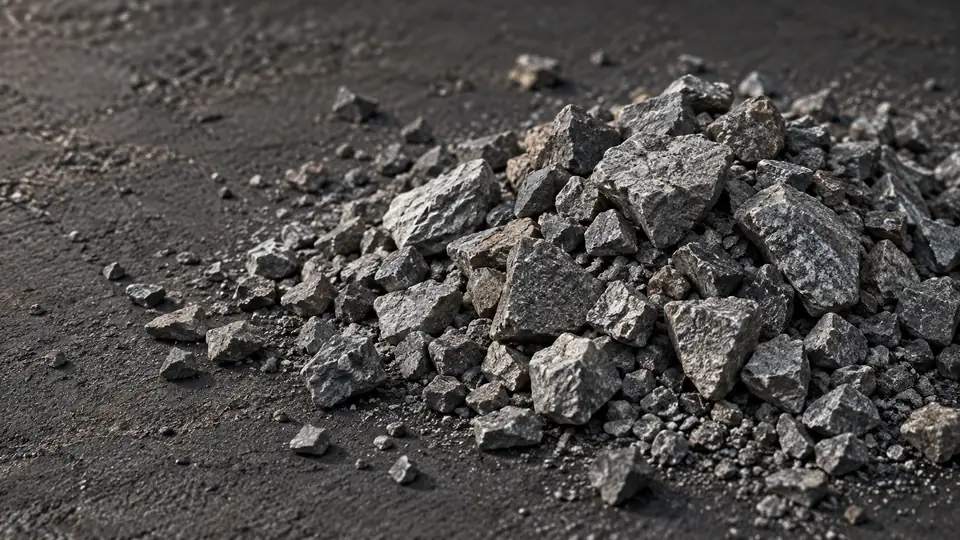
From your estimate to your order.
Measure. Check. Plan.
Measure your project
Record dimensions and separate layers before estimating.
Use the right basis
Check product specifications, units and supplier quote inclusions.
Keep your project record
Save your inputs and estimate with the print control.
On this page
Your material estimate is in cubic yards, but the supplier quotes by the ton. Choosing a conversion factor for the wrong product or condition can leave you comparing unequal quantities. The problem becomes harder when one quote uses US tons and another uses metric tonnes.
Converting cubic yards to tons starts with the material’s bulk density. Multiply volume by the correct weight per cubic yard to estimate tons. Divide tons by that same density to work backward from a delivered weight to an estimated volume.
This guide explains both directions, the differences between ton units, and how to use a supplier’s density. It includes worked gravel, sand, and soil examples, a conversion chart, and a way to show a range when density is uncertain. Every example density below is an explicitly stated assumption, rather than a universal material specification.
Quick answer: converting cubic yards to tons
US short tons = cubic yards × bulk density in US short tons per cubic yard.
If a supplier gives density in pounds per cubic yard, use:
US short tons = cubic yards × pounds per cubic yard ÷ 2,000.
For example, assume your specific gravel has a quoted density of 3,000 lb/yd³. Four cubic yards would weigh 4 × 3,000 ÷ 2,000 = 6 US short tons. A different product density produces a different answer.
How many yards in a ton?
When ordering bulk material, “yards” usually means cubic yards. There is no single number of yards in a ton because a ton measures mass and a cubic yard measures volume. You need the density and the definition of the ton.
Cubic yards per US short ton = 2,000 ÷ bulk density in lb/yd³.
At an assumed density of 3,000 lb/yd³, one US short ton occupies about 0.667 yd³. At 2,000 lb/yd³, it occupies 1 yd³. These answers describe two different assumed densities, not two interchangeable conversion rules.
What does CY mean?
CY is a common abbreviation for cubic yards. You may also see cu yd or yd³ on an estimate. A cubic yard is the volume of a cube measuring one yard on each side, equal to 27 cubic feet.
A cy to tons conversion still requires density. The abbreviation changes the label, not the calculation. Also check that a handwritten “yard” means cubic volume rather than a linear yard or square yard.
Cubic yards, tons, and density
Volume tells you how much space the material occupies
Cubic yards describe space. They can represent loose material in a pile, material delivered in a truck, or a finished layer after compaction. Those conditions should be identified before you choose a density.
Tons tell you the material’s mass
Suppliers often describe mass as weight in everyday ordering language. A stated number of tons does not identify the corresponding volume on its own. The product, its density, and the ton unit connect the two measurements.
Bulk density connects the measurements
Bulk density is mass divided by the total bulk volume, including spaces between particles. Use a value that describes the material in the relevant condition. A density for solid stone alone does not describe the same volume as a loose pile of aggregate.
ASTM C29/C29M distinguishes loose and compacted aggregate conditions and addresses voids between particles. Its public description also explains that dry test density does not automatically represent moisture and packing conditions in a hauling unit or stockpile. This is why a product-specific supplier value matters.
US short tons vs metric tonnes vs long tons
Choose the ton definition before converting. US short tons are the starting unit for this USA-focused guide, but the unit written on your quote takes priority.
| Unit | Definition | Pounds, approximately |
|---|---|---|
| US short ton | 2,000 lb | 2,000 |
| Metric ton, or tonne | 1,000 kg | 2,204.623 |
| Long ton | 2,240 lb | 2,240 |
NIST lists these as distinct mass units. A metric tonne is about 10.23% heavier than a US short ton. The same load therefore has a smaller numerical value in metric tonnes than in US short tons.
For an assumed load of 12,000 lb, the equivalents are 6 US short tons, approximately 5.443 metric tonnes, or approximately 5.357 long tons. Changing the unit changes the number, not the physical load.
Use a mass unit for material purchases
The US short ton is 2,000 lb; a metric tonne is 1,000 kg. A register ton or freight measurement ton describes volume in a different context and is not a gravel mass unit. A water-only yards-to-weight factor is unsuitable for soil, sand or stone.
Need to start from dimensions? Use the cubic yard calculator first, then enter that volume here with the supplier’s density and condition. Keep geometric need, procurement allowance and supplier minimum billing separate.
How to convert cubic yards to US tons
Step 1: establish the volume
Start with the cubic yards already calculated for your project or stated by your supplier. If you only have dimensions, calculate volume first. For a rectangular layer with length and width in feet and depth in inches:
Cubic yards = length × width × depth ÷ 324.
Use the site’s Cubic Yard Calculator for detailed measurement, multiple sections, and shape calculations. This page focuses on converting an established volume into mass.
Step 2: obtain the correct density
Ask your supplier for bulk weight per cubic yard for the exact product. Confirm whether it describes loose delivered material or compacted material. Record the density unit alongside the number.
If the supplier gives a range, preserve it. A range is more useful than presenting one guessed value as exact. Product names alone are insufficient to establish the right density.
Step 3: multiply by tons per cubic yard
Suppose your project needs 8 yd³ and the supplier’s applicable density is assumed to be 1.45 US short tons/yd³. The calculation is:
8 × 1.45 = 11.6 US short tons.
That is the mass equivalent of the stated volume at the stated density. Any ordering allowance should be calculated separately and identified clearly. Calculate volume from dimensions with the cubic yard calculator before converting it to a quoted weight.
How to convert tons to cubic yards
Reverse conversion uses division. If density is written in US short tons per cubic yard:
Cubic yards = US short tons ÷ US short tons per cubic yard.
Assume a load contains 9 US short tons and the applicable density is 1.5 US short tons/yd³. Then 9 ÷ 1.5 = 6 yd³. Multiplying 9 by 1.5 would not give the correct volume.
If the density is in pounds per cubic yard, first convert the load to pounds:
Cubic yards = US short tons × 2,000 ÷ density in lb/yd³.
How many cubic yards in a ton of gravel?
There is no fixed answer for every gravel product. At an assumed density of 1.5 US short tons/yd³, one US short ton is 1 ÷ 1.5 = 0.667 yd³. Two US short tons at the same density occupy about 1.333 yd³.
Use the density for the gravel you intend to buy. Confirm its product name, size or grading, and whether the density represents the supplied condition. A conversion for one aggregate does not establish a conversion for another. For an order starting with project dimensions, use the gravel calculator; this converter starts with an existing volume or mass.
Cubic yards to tons conversion chart
The table below shows the arithmetic at three hypothetical densities. The columns are not assigned to gravel, sand, or soil. Choose a column only if its density matches your actual material information.
| Volume, yd³ | At 1.00 US ton/yd³ | At 1.25 US tons/yd³ | At 1.50 US tons/yd³ |
|---|---|---|---|
| 0.5 | 0.50 | 0.625 | 0.75 |
| 1 | 1.00 | 1.25 | 1.50 |
| 2 | 2.00 | 2.50 | 3.00 |
| 3 | 3.00 | 3.75 | 4.50 |
| 5 | 5.00 | 6.25 | 7.50 |
| 10 | 10.00 | 12.50 | 15.00 |
| 20 | 20.00 | 25.00 | 30.00 |
All result columns show US short tons. The table is calculated from volume × assumed density; it is not a supplier density chart.
Worked example: gravel density supplied in pounds
Assume a supplier gives 2,900 lb/yd³ for the particular gravel and condition you need. Your established volume is 6.5 yd³.
6.5 × 2,900 = 18,850 lb.
18,850 ÷ 2,000 = 9.425 US short tons.
You could communicate that as approximately 9.43 US short tons, with the density assumption attached. Retain the unrounded result until the final step. Ask the supplier how it handles order increments before selecting an order quantity.
Worked example: sand density supplied in lb/ft³
Assume the applicable bulk density for your sand is 100 lb/ft³. First convert the density to pounds per cubic yard:
100 × 27 = 2,700 lb/yd³.
That equals 2,700 ÷ 2,000 = 1.35 US short tons/yd³. For 4 yd³, the estimated mass is 4 × 1.35 = 5.4 US short tons.
The assumed 100 lb/ft³ is used to demonstrate the method. It is not a recommended density for every sand product or moisture condition. For a complete sand order and bag comparison, use the sand calculator.
Worked example: soil density supplied in kg/m³
Assume a soil specification gives an applicable bulk density of 1,400 kg/m³. Convert 3 yd³ to cubic meters using 1 yd³ = 0.764554857984 m³, derived from the international yard.
3 × 0.764554857984 ≈ 2.293665 m³.
2.293664573952 × 1,400 ≈ 3,211.130 kg.
The result is approximately 3.211 metric tonnes or 3.540 US short tons. Use the original values throughout the calculation rather than the displayed rounded intermediate value. This density is hypothetical and does not describe all topsoil, fill, or amended soil. For bed geometry, mix quantities, and package counts, use the dirt calculator.
Converting a density into a usable factor
| Density unit provided | Convert to US short tons per yd³ |
|---|---|
| lb/yd³ | Divide by 2,000 |
| lb/ft³ | Multiply by 27, then divide by 2,000 |
| US short tons/yd³ | Use the stated value directly |
| kg/m³ | Multiply by 0.764554857984, then divide by 907.18474 |
| Metric tonnes/yd³ | Divide by 0.90718474 |
The constants connect volume and mass units; they do not establish a material density. For metric-tonne output from kg/m³, multiply by 0.764554857984 and divide by 1,000 instead. NIST provides the underlying unit conversions.
How to show a density range
When converting volume to tons
For a fixed volume, higher density means higher mass. Assume a supplier provides a relevant range of 1.3–1.5 US short tons/yd³. At 8 yd³, the result is 10.4–12 US short tons.
The lower result is 8 × 1.3. The upper result is 8 × 1.5. This range reflects the supplied density limits, not a statistical confidence interval.
When converting tons to volume
For a fixed mass, higher density means less volume. At 12 US short tons and the same assumed density range, the volume is:
Minimum: 12 ÷ 1.5 = 8 yd³.
Maximum: 12 ÷ 1.3 ≈ 9.231 yd³.
The estimated range is 8–9.231 yd³. Notice that the density endpoints switch roles in the reverse calculation.
Why moisture changes the conversion
Water contributes to the mass of a delivered material. The corresponding bulk volume can also change with moisture and packing, so a dry density is not automatically a delivered wet density. ASTM’s public aggregate density description specifically identifies moisture and bulking as relevant differences.
For a simple sensitivity example, suppose two applicable density measurements are 1.30 and 1.50 US short tons/yd³. At the same 5 yd³ volume, the results would be 6.5 and 7.5 US short tons. These are hypothetical measurements, not a universal dry-to-wet adjustment.
Loose delivery vs compacted finished volume
Compaction changes the volume occupied by material as particles rearrange. If no material or water is added or lost, compacting a load does not create extra mass. It changes the relationship between that mass and its occupied volume.
Suppose a finished layer needs 5 yd³ at an assumed compacted density of 1.6 US short tons/yd³. Its mass would be 8 US short tons. If the same material is delivered at an assumed loose density of 1.3 US short tons/yd³, that mass corresponds to approximately 6.154 loose yd³.
Do not apply another generic compaction allowance to this example without establishing what it represents. Using both a compacted-density calculation and an overlapping allowance can count the same volume difference twice. Have the supplier or project specification confirm the appropriate condition.
Comparing prices per ton and per cubic yard
A lower numerical unit price does not necessarily mean a cheaper material. Convert both quotes to the same unit using the applicable density. Keep delivery, tax, and other charges separate until the material quantities are comparable.
Price per yd³ = price per US short ton × US short tons per yd³.
With a hypothetical price of $40 per US short ton and density of 1.5 US short tons/yd³, the material price is $60 per yd³. Conversely, a hypothetical $60/yd³ quote at that density equals $40 per US short ton. These numbers illustrate the calculation and are not current market prices.
This comparison is meaningful only when product, condition, and included charges match. A different density or different product makes the same unit-price conversion insufficient for comparing value.
Questions to ask your material supplier
If the specified material is crusher run, the crusher run order calculator combines matching density with both truck volume and payload limits and rounds up to actual trips.
Before converting or ordering, ask:
- What is the exact product name and grading?
- Is the quantity sold in US short tons, metric tonnes, cubic yards, or another unit?
- What bulk density applies to this product as supplied?
- What are the density units and its loose, compacted, dry, or moist condition?
- Is the quoted density a measurement, an estimate, or a range?
- Does the quoted volume describe delivery volume or finished installed volume?
- What order increments, minimum quantities, and delivery charges apply?
Record the answers with your estimate. Keeping the density source makes a later recalculation easier if the product or delivery conditions change.
What a tons-to-yards result can tell you
The result estimates bulk volume at the density you entered. It can help reconcile a volume estimate with a mass quote or translate a stated load into planning volume. It does not independently measure the delivered pile.
Two loads with the same mass can occupy different volumes when their bulk densities differ. Likewise, a converted loose volume is not automatically the finished compacted volume. Keep the condition visible when sharing the result.
Common conversion mistakes
Using 1.4 for every material
A factor such as 1.4 US short tons/yd³ only applies when it matches the material’s relevant density. It is not a volume-unit conversion like 27 cubic feet per cubic yard. Recheck the density when changing products.
Multiplying when converting tons to yards
Multiply volume by mass per unit volume to find mass. Divide mass by mass per unit volume to find volume. As a quick check, 3 US short tons at 1.5 US short tons/yd³ must equal 2 yd³.
Mixing metric and US ton labels
A density in metric tonnes/yd³ cannot be used as though it were US short tons/yd³. Convert the density or normalize the mass units first. Write the full unit beside both input and output.
Rounding too early
Keep full precision while converting units and applying density. Round the final result for readability. A displayed three-decimal answer is not a claim that the supplied density is accurate to three decimals.
Calculation and scope notes
Tables and worked examples are original arithmetic using explicitly hypothetical density inputs. They are not measured product densities, live supplier quotes, or recommended order allowances.
Frequently asked questions
How many cubic yards in a ton?
Divide one ton by the applicable density expressed in that same ton unit per cubic yard. At 1.25 US short tons/yd³, one US short ton equals 0.8 yd³. The answer changes when density or ton type changes.
Is one cubic yard equal to one ton?
Only if the applicable density is one of the selected tons per cubic yard. At 1.5 US short tons/yd³, one cubic yard equals 1.5 US short tons. Volume and mass do not have a universal one-to-one relationship.
How many tons are in 10 cubic yards?
Multiply 10 by the density in tons per cubic yard. At an assumed 1.45 US short tons/yd³, the result is 14.5 US short tons. Confirm the product density before using that estimate for an order.
Can I convert cubic yards to tons without density?
You need a density or an equivalent mass-and-volume relationship. A material label alone does not establish an exact conversion. Ask the supplier for a value or an applicable range.
What if my supplier gives pounds per cubic foot?
Multiply that value by 27 to get pounds per cubic yard. Then divide by 2,000 to get US short tons per cubic yard. At an assumed 90 lb/ft³, the factor is 1.215 US short tons/yd³.
Are tons and tonnes the same?
A tonne means a metric ton of 1,000 kg. A US short ton means 2,000 lb, while a long ton means 2,240 lb. Confirm the unit when a quote only says “ton.”
Does this replace a gravel project calculator?
Use this conversion method when you already know a volume or mass. Use the Gravel Calculator for project quantities, or the Cubic Yard Calculator for measurement and shapes. Conversion, geometry, and installation planning are related tasks with different inputs.
Understand the estimate and its assumptions
Read the formulas and worked examples on this page alongside the entered values. Geometry estimates space; density converts volume to mass; product yield converts a quantity to packages. An allowance and supplier purchase rounding are separate adjustments.
Use the same material condition and units as the supplier specification. Enter a local quoted price when pricing work. Missing fees remain unresolved, and a material subtotal does not establish an installed project price. Example values illustrate arithmetic and are not local quotes or construction specifications.
Keep the printed input record with your estimate so a supplier or contractor can check the values that produced it.