
Driveway Fabric: How to Choose and Install Geotextile Under Gravel
When fresh gravel starts disappearing into soft ground, buying another truckload may leave you with the same ruts next season. Choosing driveway fabric can be just as frustrating: rolls described as “heavy duty” may have different strength, water-flow and installation requirements, even when they look similar.
The right geotextile fabric for a driveway is chosen for a specific job within the gravel-and-soil system. It may separate materials, support a stabilization design or provide filtration, but it must suit the ground, vehicle loads and construction method.
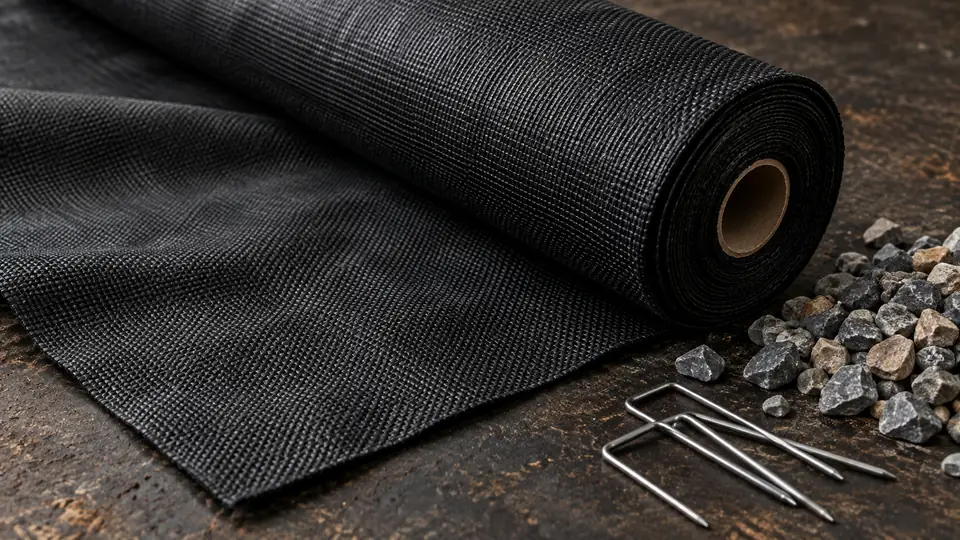
This guide explains how to make that choice, read product data, plan rolls and seams, and check installation before the fabric is buried. It focuses on vehicle-loaded gravel driveways, with practical buying questions and a clearly labeled roll-layout example.
On this page
What driveway fabric does—and what it cannot fix
Driveway fabric is commonly placed at a specified interface between prepared ground and an aggregate layer. Its purpose is determined by the design, rather than by the word “driveway” on the packaging. A separator can help keep soil and aggregate from mixing; that is different from repairing a blocked culvert or correcting inadequate aggregate thickness.
The Federal Highway Administration’s geotechnical manual distinguishes separation, filtration and reinforcement functions. It explains why a geotextile and a geogrid may have different roles, and why selection must account for the soil and the complete aggregate section. This is technical background from a legacy manual, not a current residential specification.
| Function | What you are trying to achieve | Question to ask |
|---|---|---|
| Separation | Keep the specified aggregate and underlying soil from intermixing | Which interface needs separation? |
| Filtration | Allow water passage while retaining the relevant soil particles | Is the product compatible with this soil and flow condition? |
| Stabilization / reinforcement | Support a designed response to weak ground or aggregate movement | What product properties and aggregate section does the design require? |
| Drainage | Provide the intended water movement within an appropriate system | Where does the water go, and which component carries it? |
Does driveway fabric work?
It can perform its specified function when the product and installation match the application. That does not mean every driveway needs fabric or that a roll guarantees freedom from ruts. Ask what failure the proposed fabric addresses and how the installer will protect it during construction.
If your existing driveway keeps sinking or developing muddy wheel tracks, begin with the gravel driveway repair guide. Establish the cause before deciding to excavate and add a separator.
What it is not a substitute for
- A functioning drainage route and suitable finished surface profile.
- Adequate aggregate selected and placed for the intended traffic.
- Assessment of unsuitable, highly variable or persistently wet ground.
- Correct construction access, compaction and ongoing surface maintenance.
Do not reduce the designed aggregate thickness simply because a sales page promises gravel savings. Any change to the section needs justification for the actual site, product and loading.
Measure. Check. Plan.
Measure your project
Record dimensions and separate layers before estimating.
Use the right basis
Check product specifications, units and supplier quote inclusions.
Keep your project record
Save your inputs and estimate with the print control.
Start with a site brief, not a roll weight
Give the supplier or designer the same information you would give an installer. “Residential driveway” alone does not distinguish a firm, lightly used parking area from a wet access road used by delivery trucks.
- Ground: known soil conditions, previous fill, soft pockets, seasonal wetness and observed seepage.
- Traffic: ordinary cars, trailers, deliveries, service vehicles and unusual heavy loads.
- Geometry: driveway width, curves, slopes, parking areas and transitions.
- Water: surface runoff, existing drainage and any proposed changes.
- Construction: equipment access, placement direction and the planned aggregate layers.
- Existing material: whether the driveway is new, being reconstructed, or receiving a limited repair.
When a site assessment matters most
Seek qualified assessment where the ground cannot support the planned work, buried fill is uncertain, or failure recurs under wet conditions. Describe what you have observed; do not estimate a soil-strength value from how the ground looks.
CBR, or California Bearing Ratio, is a soil-strength measure used in some design and installation guidance. A homeowner’s photograph does not establish CBR or justify choosing an overlap from a CBR-based table.
When you may not need to disturb a sound driveway
Installing driveway base fabric beneath an existing section can require substantial access to the relevant layer. If the driveway performs well and only needs routine surface work, ask what benefit would justify that disturbance. Fabric is easier to plan into a new or genuinely reconstructed section than to treat as an automatic maintenance upgrade.
Driveway fabric vs. landscape fabric
A garden weed barrier and a construction geotextile should not be treated as interchangeable because both are black sheets sold in rolls. For a vehicle-loaded driveway, ask for the required engineering properties and installation instructions.
University of Illinois Extension’s landscape-fabric discussion explains why weeds can establish above a garden barrier and why fabric can complicate planting. Those horticultural concerns do not establish that a correctly specified roadway geotextile is unsuitable.
Should I use landscape fabric under a gravel driveway?
If “landscape fabric” is just the retailer’s broad category, identify the exact product. If it is a weed-control sheet without the needed construction data, do not assume it fulfills a driveway specification. Choose for the intended structural or filtration function rather than a weed-free promise.
The best weed barrier under a gravel driveway is also the wrong starting question when the real problem is soil-and-aggregate mixing. Separate that decision from vegetation management at the driveway edge.
Decorative gravel is a different decision
A planted rock bed, garden path or decorative gravel patio has different use and maintenance questions. Keep those areas separate in your project brief instead of buying one material for every gravel surface on the property.
Woven or nonwoven: compare the exact product
Woven geotextile for a driveway is a product category, not a complete specification. Likewise, “nonwoven” does not tell you every relevant strength or hydraulic value. Look for the exact style number and its current technical data sheet.
Read the construction description
Manufacturers describe products using terms such as slit-film woven, other woven yarn constructions and needlepunched nonwoven. These descriptions help identify the product; they do not replace the property comparison. Solmax’s soft-soil stabilization discussion describes woven products designed to combine mechanical and hydraulic functions.
As examples, the US Fabrics US 200 sheet identifies a slit-film woven geotextile, while the Solmax MIRAFI 160N sheet identifies a needlepunched nonwoven. These are specification examples, not tested recommendations for your site.
Do not choose by color, ounces or marketing grade alone
“Black geo fabric,” “commercial grade” and a stated fabric weight are incomplete buying criteria. Ask which performance properties meet the project requirement, and whether the listed values are minimums, maximums or typical values.
Terms such as driveway cloth, road fabric and geotextile membrane may help you find products. Once you request a quote, use the manufacturer and style number so a different sheet is not substituted under the same broad name.
How to read a geotextile specification
Compare the same test method, units and reporting basis. A higher number under a different test is not automatically a stronger or more suitable replacement. Keep the revision or retrieval date with each document. CBR puncture on a fabric sheet is a puncture-test result, not the underlying soil's CBR value.
The WINFAB 2197 sheet, for example, reports grab and wide-width tensile under separate test methods and units. That is a useful reminder to compare like with like rather than matching the largest displayed number.
| Property to request | What to compare | Common mistake |
|---|---|---|
| Grab tensile and elongation | ASTM D4632 values, directions and reporting basis | Treating a laboratory tensile value as a vehicle weight limit |
| Wide-width tensile, when specified | ASTM D4595 values and required strain level | Comparing them directly with grab tensile numbers |
| CBR puncture | ASTM D6241 results and the specified requirement | Substituting an unrelated puncture test |
| Apparent opening size (AOS) | ASTM D4751 value and the soil-retention requirement | Assuming the smallest opening is always best |
| Permittivity / water-flow data | ASTM D4491 values and the intended hydraulic function | Using water-flow numbers to guarantee site drainage |
| UV resistance | The stated test duration and retained-strength basis | Turning a laboratory exposure test into a service-life promise |
Three published examples: different properties, different decisions
The table is a reading exercise using manufacturer-published values. It is not a ranked “best driveway fabric” list or approval to substitute one product for another.
| Published property | US 200 | WINFAB 315W | MIRAFI 160N |
|---|---|---|---|
| Construction | Woven slit-film | Woven | Needlepunched nonwoven |
| Grab tensile, D4632 | 200 lb | 315 × 315 lb | 160 / 160 lb, MD / CD |
| CBR puncture, D6241 | 700 lb | 900 lb | 410 lb |
| AOS, D4751 | 0.425 mm | 0.425 mm | 0.212 mm |
| Permittivity, D4491 | 0.05 s⁻¹ | 0.08 s⁻¹ | 1.5 s⁻¹ |
US 200
- Construction
- Woven slit-film
- Grab tensile, D4632
- 200 lb
- CBR puncture, D6241
- 700 lb
- AOS, D4751
- 0.425 mm
- Permittivity, D4491
- 0.05 s⁻¹
WINFAB 315W
- Construction
- Woven
- Grab tensile, D4632
- 315 × 315 lb
- CBR puncture, D6241
- 900 lb
- AOS, D4751
- 0.425 mm
- Permittivity, D4491
- 0.08 s⁻¹
MIRAFI 160N
- Construction
- Needlepunched nonwoven
- Grab tensile, D4632
- 160 / 160 lb, MD / CD
- CBR puncture, D6241
- 410 lb
- AOS, D4751
- 0.212 mm
- Permittivity, D4491
- 1.5 s⁻¹
See the linked US 200 and MIRAFI sheets above and the WINFAB 315W data sheet for the full reporting notes. MD and CD identify machine and cross-machine directions. The sheets use minimum-value conventions for relevant properties and maximum conventions for opening size; do not label every value an average.
Check the specification edition and exceptions
A statement about meeting a named standard must identify its edition, application and class. The US 200 sheet cites AASHTO M-288-06 and also marks certain properties as historical reference values. Do not silently convert that statement into compliance with a newer project requirement.
Ask the approving party to confirm any proposed equivalent in writing. Similar-looking values on a retailer page are not sufficient evidence of full equivalence.
Where does fabric belong under a gravel driveway?
For a separation application, the layout should identify the soil-and-aggregate interface being protected. An illustrative arrangement is shown below; it does not specify layer thickness or authorize the same detail for every site.
Existing aggregate does not always mean full removal
The US Fabrics separation-installation guide allows some existing smaller stone to remain in its general procedure. That is not permission to bury any contaminated or unstable material. Confirm the prepared interface and repair scope with the person responsible for the design.
Fabric does not choose your aggregate
The separator specification and aggregate specification need to work together. If a quote proposes a numbered material, check the #57 stone guide to understand that label, then confirm the material required by your own driveway detail. A fabric roll is not evidence that any available gravel will suit the section.
Geotextile is not a waterproof liner
“Driveway liner fabric” can be a misleading search phrase. If the plan requires water passage, do not replace the specified geotextile with an impermeable sheet. Filtration and water containment are different functions; a product sold for one should not be assumed to perform the other.
Plan roll width, overlap and seams before ordering
A driveway fabric roll has a gross area, but the installed coverage also depends on seams, trimming and the footprint you must protect. Use the width of the designed covered section, including any specified extensions—not just the visible wheel tracks.
Is 12-foot-wide driveway fabric wide enough?
Measure against the actual supplied width. A listing described loosely as “12 wide” may need confirmation before it can be used in a cut plan. Ask for both width and length, whether the roll is full or precut, and the permitted seam arrangement.
Why there is no universal overlap
The WINFAB separation/stabilization installation guide relates overlap to subgrade strength and identifies conditions needing a sewn seam. Its table gives 1.5 feet for the stated CBR-above-2 case. Use the approved requirement for your project; do not assign that condition by visual inspection.
Confirm side overlaps, end overlaps, seam direction, required joining and treatment at curves. Pins can hold material temporarily, but do not assume they provide a specified structural seam.
Worked example: two panels and one longitudinal seam
Illustrative plan only: a designer has specified a 20-foot-wide, 100-foot-long covered footprint and approved a 1.5-foot side overlap for this scenario. There are no curves, end seams, edge returns or additional pads. The product is assumed to be suitable independently of the arithmetic.
A published US 200 packaging option is 12.5 × 432 feet. Two 100-foot panels cut from that roll provide 12.5 + 12.5 − 1.5 = 23.5 feet of combined width before trimming.
- Fabric used in the two panels: 2 × 12.5 × 100 = 2,500 square feet.
- Specified footprint: 20 × 100 = 2,000 square feet.
- Side overlap: 1.5 × 100 = 150 square feet.
- Width trimming across the length: 3.5 × 100 = 350 square feet.
- Remaining uncut roll length: 432 − 200 = 232 feet.
The extra 500 square feet in the cut panels is accounted for by overlap and trimming. It is not a generic “waste percentage.” The remaining roll and any usable offcuts are separate from that installed-layout calculation.
Full-roll purchasing is a separate decision
A cheaper full roll can still create a larger purchase than a suitable precut option. Confirm available sizes, cutting terms and freight with the seller; the packaging example is not a live stock promise.
Driveway fabric installation: agree on the sequence
Use the selected product’s instructions together with the approved project detail. Before starting, record the placement interface, overlap or seam requirements, aggregate placement method and equipment restrictions.
1. Accept the prepared ground
Check that the agreed preparation is complete and that unresolved wet or unsuitable areas have been addressed. Protect the fabric from protruding objects and the damage hazards identified in the installation plan. Complete the applicable utility-location process before excavation.
Do not assume all site conditions require the same excavation method. US Fabrics’ general guide discusses exceptions for very soft ground, while other manufacturer procedures describe different preparation. Resolve the actual detail rather than combining unrelated instructions.
2. Verify and protect the delivered rolls
The Solmax nonwoven installation-quality manual describes checking roll identity, delivery records and visible damage, and protecting material during storage. It is a manufacturer-authored reference for its nonwoven products, not a universal woven-fabric manual.
Compare labels with the approved order before removing the wrapping. Record damaged packaging and arrange suitable unloading. Ask the supplier for roll weight and handling requirements; a full construction roll may need a different delivery plan from a small retail package.
3. Place panels and confirm seams
Follow the approved orientation and lay the fabric in contact with the prepared surface, without unwanted folds or displaced panels. Check the measured overlaps before covering them. Temporary holding methods should follow the product and site requirements.
If sewing or another joining method is specified, obtain its required detail and inspection procedure. Do not improvise a structural seam with garden staples, household adhesive or a larger guessed overlap.
4. Place aggregate without defeating the installation
Confirm how the first material will be placed and how equipment will advance. Manufacturer instructions differ: WINFAB’s guide prohibits vehicles directly on its exposed geotextile, while US Fabrics’ separation guide permits certain direct traffic under stated conditions. Do not transfer that permission between products.
Choose an approved placement route before the truck arrives. Monitor fabric movement and stop to correct displaced seams or damage before they are hidden. Equipment cover requirements and initial placement thickness must come from the applicable plan.
5. Complete compaction and record the covered work
Use the specified aggregate and compaction procedure for the section. If construction reveals different ground conditions, obtain a revised direction rather than quietly changing the material or method.
Photograph roll labels, panel positions, seams and repairs before cover. Once the aggregate section and depths are confirmed, use the gravel driveway calculator for the associated stone requirement. Fabric area does not establish gravel volume.
Geotextile, geogrid and “geo mesh” are not synonyms
A mesh or grid may be proposed for a different function from a continuous textile separator. Ask what product the quote means by “geo mesh driveway,” “geomat” or “stabilization fabric.” The generic name cannot tell you whether soil retention, reinforcement or another function is provided.
If the plan includes both a grid and a geotextile, confirm their order and individual roles. Do not remove one because the other appears tougher, and do not assume one purchasing category covers every component in the design.
Driveway fabric cost: compare the supplied job, not just the roll
Driveway fabric prices depend on the actual style, supplied dimensions and purchasing terms. A useful comparison also accounts for required coverage, seams, cuts and delivery. Request a dated quote rather than using an undated national price range.
| Quote item | What to confirm |
|---|---|
| Product identity | Manufacturer, style, data-sheet version and approved alternatives |
| Supplied quantity | Roll width, length, count and full-roll or precut terms |
| Layout requirement | Required footprint, seams, trimming and remaining material |
| Delivery | Destination freight, unloading responsibility and access arrangements |
| Other charges | Applicable tax, cutting charges, returns and special-order restrictions |
| Installation scope | Preparation, joining, placement, inspection and excluded work |
Where to buy driveway fabric
Consider a geosynthetics distributor, a construction-material supplier or a retailer that can identify the specified product. Searches for driveway fabric on Amazon, Tractor Supply or Home Depot are starting points for checking a listing—not evidence that the right style is currently available for your address.
Request the technical sheet, exact dimensions and shipping terms from the seller. Check product substitutions and returns before purchase. This guide does not verify those retailers’ present stock or provide affiliate recommendations.
Questions to send with a quote request
- Can you supply this exact approved style and dimensions?
- Which current technical sheet and installation guide apply?
- Is the stated price for a full roll, precut length or another unit?
- What arrives at my address, and how must it be unloaded?
- What happens if the supplied style or dimensions differ from the order?
A roll price is only one part of the fabric order
Live Oak Supply’s Gro Green DF12300 listing shows a 12 × 300 ft roll at $265. Its 3,600 ft² is gross area, about $0.074 per gross ft² before freight and tax. Side seams, trimming and your required cutting plan reduce usable coverage. This is an untested retail example, not a performance recommendation.
The listing’s marketing description does not by itself prove the test properties or site suitability. Obtain the exact technical sheet, quote freight to your address, confirm stock/returns and damage claims, and calculate whole-roll purchases above. Decorative beds belong in landscape fabric under gravel; vehicle-load separation is a different decision.
Damage, exposed fabric and product substitutions
If the fabric tears before cover
Record the damage, keep the area accessible and obtain the applicable repair detail. A small puncture and a failed seam may need different treatment. US Fabrics’ separation guide gives a fallback patch overlap where project instructions are absent; do not adopt that detail for an unrelated product.
Inspect the repair before replacing the cover. A photograph of the patched area and its measured dimensions provides a useful record of what was actually done.
If fabric becomes visible later
Investigate why it is exposed: lost cover, erosion, material displacement or another construction problem. Do not simply cut it away or assume another thin gravel topping solves the cause. The appropriate correction depends on the function and location of the affected material.
If the installer proposes an equivalent
Ask for the replacement’s technical sheet and a written comparison against every required property. Include the relevant installation conditions, not only tensile strength. Obtain approval before installation and keep the substituted product’s identity in the project record.
Before the geotextile is buried: an acceptance checklist
- The delivered manufacturer and style match the approved order.
- The prepared surface and unresolved weak areas have been reviewed.
- The location and full covered footprint match the layout.
- Panel orientation and measured overlaps or seams meet the agreed detail.
- Damage has been documented, repaired and checked.
- Temporary holding and aggregate placement do not displace the fabric.
- Equipment operation follows the applicable product and project restrictions.
- The specified aggregate placement and compaction procedure are understood.
- Photographs, roll identification and any approved changes are retained.
Agree who checks these items and when. Some require approval before material is covered; a walk-through after the driveway is finished cannot reveal every buried seam.
Frequently asked questions
What is the best geotextile fabric for a gravel driveway?
The product that meets the assessed site, specified function and installation requirements. Compare mechanical and hydraulic properties, reporting notes and construction survivability. A universal winner chosen from weight or price alone leaves important questions unanswered.
Can driveway filter fabric fix a muddy road?
A geotextile may form part of an assessed stabilization or separation system. “Filter fabric” alone does not define that system or remove a water source. Persistent mud requires a plan for the ground, water and aggregate together.
Can I install fabric over an existing gravel driveway?
It depends on the intended interface and the condition of the existing material. Ask what the new fabric is meant to separate and whether the proposed construction allows that function. A sheet below a new topping is not automatically equivalent to a separator at the subgrade.
Will driveway fabric stop all weeds?
No weed-free result is promised by this guide. Seeds and organic debris can establish vegetation above a barrier. Select driveway geotextile for its specified construction function and manage vegetation separately.
How much overlap should I use?
Use the approved requirement for the particular product, ground and placement method. Confirm end seams as well as side seams. If the instructions rely on soil-strength values, obtain the necessary assessment rather than estimating them by appearance.
Can I drive on the fabric before adding gravel?
Only where the applicable product and project instructions expressly allow it under the planned conditions. The manufacturer guides reviewed here do not give identical permissions. Arrange the construction route before unloading.
How long does driveway fabric last?
No universal service life can be established from a product name or UV test alone. Ask the manufacturer about the specific application, storage limits, exposure and warranty terms. Keep installation records so future work can identify the buried material.
Can the same fabric go under asphalt, concrete or pavers?
Do not extend a gravel-driveway detail to another pavement assembly without approval. Those applications have their own interfaces and specifications. Confirm the complete proposed system before reusing leftover material.
Before ordering, aim to resolve four things: the fabric’s job, the exact product, the installation detail and the roll layout. Those decisions make the purchase useful—and make the buried work possible to check.