
Cubic Yard Calculator: Cubic Feet, Inches and Coverage
A material order can be wrong even when your length and width measurements are correct. Depth measured in inches, a quote priced by the cubic yard, and bags labeled in cubic feet leave several opportunities for a unit mistake. An uneven footprint or an unverified ordering adjustment can increase the difference between the estimate and what the project needs.
A cubic yard calculator helps you turn those measurements into a consistent volume. Calculate cubic feet and cubic yards from dimensions, work from a known area and depth, or convert an existing volume between cubic units. When you already have material, reverse the calculation to find the area it can cover at your chosen depth.
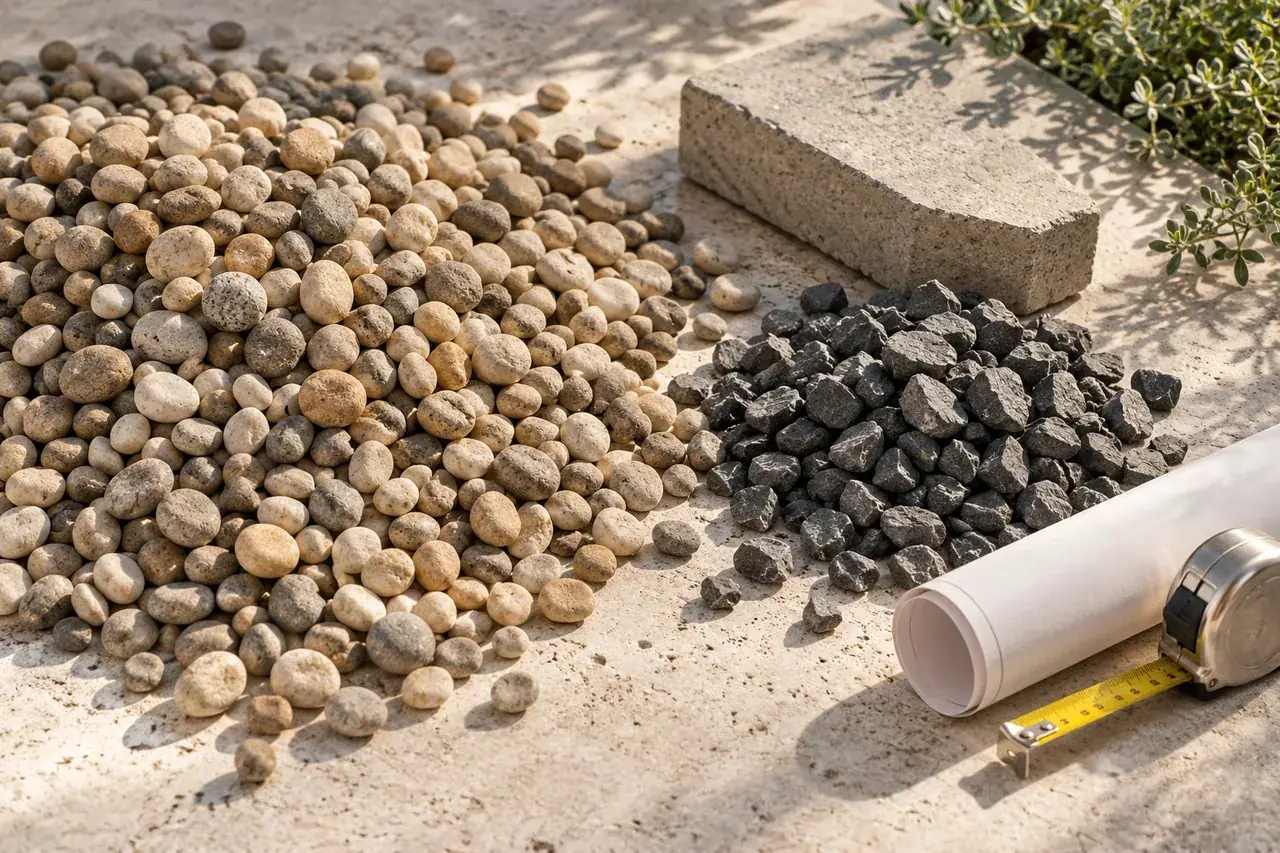
This guide explains the measurements, formulas and conversions behind the result. You will find worked examples for different shapes, coverage tables, bag calculations and a supplier checklist. Keep the measured volume separate from any allowance, loose-material conversion or supplier rounding before placing an order.
Calculate your volume
Clear units. Visible formulas. No signup.
Your result
Measure. Check. Plan.
Measure your project
Record dimensions and separate layers before estimating.
Use the right basis
Check product specifications, units and supplier quote inclusions.
Keep your project record
Save your inputs and estimate with the print control.
On this page
Choose the Right Calculation Method
Start with the information you actually have. Dimensions describe a space; a known volume describes an amount of material. Area alone does not establish volume until you provide a depth.
| Starting information | Calculation | What else you need |
|---|---|---|
| Length and width | Project volume | Depth and measurement units |
| A circular or other shaped footprint | Shape area, then volume | Correct shape dimensions and depth |
| Known square footage | Area to volume | Depth |
| Existing cubic feet, yards, inches or meters | Cubic-unit conversion | Original volume unit |
| Available material and intended depth | Coverage area | Volume and depth in compatible units |
A yardage calculator should identify whether it is calculating a new volume or converting one you already know. In this guide, “yardage” means cubic material volume, rather than fabric length or another linear measurement.
What Is a Cubic Yard?
A cubic yard is the space inside a cube measuring 3 feet long, 3 feet wide and 3 feet high. Its volume is 3 × 3 × 3, which equals 27 cubic feet.
The cube is a way to visualize the unit, not the required shape of your project. A shallow layer, a narrow trench and a rectangular container can hold the same volume with very different dimensions.
How Big Is a Cubic Yard?
One cubic yard also equals 46,656 cubic inches or exactly 0.764554857984 cubic meters. The conversion applies to the volume unit regardless of the material occupying that space.
These relationships appear in the volume tables published by the National Bureau of Standards, now NIST: Units of Weight and Measure: Definitions and Tables of Equivalents.
How Much Is a Cubic Yard?
As a quantity, it is always 27 cubic feet. As a purchase, its price depends on the actual material and the supplier’s quote.
Ask whether “a yard” means a cubic yard and whether the price includes delivery or other charges. A loader scoop is not a verified unit unless the supplier specifies its delivered volume.
What Is a Cubic Foot?
A cubic foot is the volume of a cube measuring 1 foot on every edge. It is abbreviated ft³ or cu ft; cubic footage means volume expressed in those units.
You may also encounter cft or cuft in calculator labels and quotations. Confirm that the label refers to cubic feet, especially when the same document includes square feet or linear feet.
Square Feet, Cubic Feet and Linear Feet
Square feet measure a surface area. Cubic feet measure a three-dimensional volume, and linear feet measure length.
A 10-by-10-foot footprint has an area of 100 square feet. Its volume is 25 cubic feet at 3 inches deep, but 50 cubic feet at 6 inches deep. The footprint stays the same while the volume doubles.
How to Measure Cubic Feet
Measure the space’s length, width and depth or height. Record a unit beside every measurement before entering it into a cubic feet calculator.
For a rectangular material layer, measure the footprint and the intended thickness separately. For a container, use usable interior dimensions; outside dimensions can include wall thickness and unusable space.
Convert Feet and Inches Correctly
Convert the inches portion to feet by dividing it by 12, then add the whole feet. A measurement of 8 feet 6 inches is 8 + 6 ÷ 12 = 8.5 feet.
Do not enter 8 feet 6 inches as 8.6 feet. That decimal represents a different length and changes the result when multiplied by the other dimensions.
Measure Uneven Depths Separately
Where thickness changes, divide the footprint into areas with their own representative depths. Multiply each area by its depth, then add the volumes.
If depth varies uniformly over a rectangular footprint, the average of the end depths can represent the mean thickness. Irregular hollows need more measurements; a guessed average can conceal substantial extra volume.
How to Calculate Cubic Feet
For a rectangular space, use:
Cubic feet = length in feet × width in feet × depth in feet
For example, a space measuring 8.5 feet by 4 feet by 1.5 feet contains 51 cubic feet. Keep the original dimensions with the result so another person can check the estimate.
Depth in Inches
When length and width are in feet, use:
Cubic feet = length × width × depth in inches ÷ 12
A 24-by-8-foot area at 4 inches deep contains 64 cubic feet: 24 × 8 × 4 ÷ 12. The division by 12 converts thickness, not the footprint.
Figuring Cubic Footage From a Known Area
If you already know the area, there is no need to recreate its length and width. Multiply that area by the depth in feet.
For 300 square feet at 2 inches deep, calculate 300 × 2 ÷ 12 = 50 cubic feet. This is also how to determine cubic feet from a surveyed or separately measured footprint.
How to Calculate Cubic Yards
First calculate the volume in cubic feet, then divide by 27:
Cubic yards = cubic feet ÷ 27
The 64-cubic-foot example becomes 64 ÷ 27 = approximately 2.37037 cubic yards. Displaying 2.37 is convenient, but retain the unrounded figure until the final ordering decision.
Feet and Inches Shortcut
For length and width in feet and depth in inches:
Cubic yards = length × width × depth in inches ÷ 324
The denominator is 12 × 27. Using 324 when depth is already in feet would produce a result twelve times too small.
Dimensions Entirely in Yards
When all three measurements are in yards, multiply them directly. A 2-yard-by-1.5-yard space at 0.5 yard deep contains 1.5 cubic yards.
Do not divide that answer by 27 again. The unit of the result follows the units used for all three dimensions.
Cubic Feet to Cubic Yards
Divide the cubic-foot value by 27. This is the same conversion whether a label says cubic ft to cubic yards, cu ft to yd³, or spells out both units.
81 cubic feet ÷ 27 = 3 cubic yards
| Cubic feet | Cubic yards |
|---|---|
| 1 | 0.037037… |
| 13.5 | 0.5 |
| 27 | 1 |
| 54 | 2 |
| 81 | 3 |
| 135 | 5 |
A cubic yard estimator should show both units together when checking a bulk order against bag labels. They are different expressions of the same volume.
Cubic Yards to Cubic Feet
Multiply the cubic-yard value by 27:
Cubic feet = cubic yards × 27
For example, 2.5 cubic yards equals 67.5 cubic feet. Labels such as cubic yd to cubic ft use the same relationship.
How Many Cubic Feet in a Yard?
If “yard” means a cubic yard of material, there are 27 cubic feet in a yard. A linear yard is only a length of 3 feet and cannot be converted directly into volume.
Clarify the supplier’s unit instead of assuming every use of “yard” means cubic yard. That distinction also matters when measuring edging, fabric or a project boundary.
Square Feet to Cubic Yards
You need a thickness before converting square feet to cubic yards:
Cubic yards = square feet × depth in inches ÷ 324
A 450-square-foot footprint at 4 inches deep contains approximately 5.55556 cubic yards. At 2 inches deep, the same footprint contains approximately 2.77778 cubic yards.
Sq Ft to Cubic Yards at Common Depths
The table shows geometric volume only. Depths are calculation examples, not recommendations for a particular installation.
| Area | At 2 inches | At 3 inches | At 4 inches | At 6 inches |
|---|---|---|---|---|
| 100 sq ft | 0.617 yd³ | 0.926 yd³ | 1.235 yd³ | 1.852 yd³ |
| 250 sq ft | 1.543 yd³ | 2.315 yd³ | 3.086 yd³ | 4.630 yd³ |
| 450 sq ft | 2.778 yd³ | 4.167 yd³ | 5.556 yd³ | 8.333 yd³ |
| 750 sq ft | 4.630 yd³ | 6.944 yd³ | 9.259 yd³ | 13.889 yd³ |
Square Feet to CFT
For square feet to cft, multiply area by depth in feet. If thickness is measured in inches, divide that thickness by 12 first.
There is no fixed amount of cubic feet in a square foot. One square foot at 1 foot deep contains 1 cubic foot; at 1 inch deep, it contains 1/12 of a cubic foot.
Cubic Feet to Square Feet
Divide volume by the selected depth in feet:
Square feet = cubic feet ÷ depth in feet
For 60 cubic feet spread 4 inches deep, calculate 60 ÷ (4 ÷ 12) = 180 square feet. Searches for cft to square feet or cubic feet to ft sq refer to this depth-dependent calculation.
Do not apply an ordering allowance to material you already have when reporting its actual coverage. If some material will be lost or unavailable, enter the usable volume separately.
How Much Area Does One Cubic Yard Cover?
One cubic yard contains 27 cubic feet. Divide that volume by the intended layer thickness to determine coverage.
Coverage in square feet = cubic yards × 324 ÷ depth in inches
| Depth | Coverage from 1 cubic yard | Coverage from 2 cubic yards |
|---|---|---|
| 1 inch | 324 sq ft | 648 sq ft |
| 2 inches | 162 sq ft | 324 sq ft |
| 3 inches | 108 sq ft | 216 sq ft |
| 4 inches | 81 sq ft | 162 sq ft |
| 5 inches | 64.8 sq ft | 129.6 sq ft |
| 6 inches | 54 sq ft | 108 sq ft |
| 12 inches | 27 sq ft | 54 sq ft |
These figures assume that the measured volume becomes a uniform layer at the stated thickness. Loose-to-finished conversion, uneven ground and handling losses require separate consideration.
How to Calculate Cubic Inches
Multiply length, width and height when all three measurements are in inches:
Cubic inches = length in inches × width in inches × height in inches
A container with usable dimensions of 18 by 12 by 8 inches holds 1,728 cubic inches. A cubic inch calculator can then express that volume in cubic feet, yards or metric units.
How Many Cubic Inches in a Cubic Foot?
There are 1,728 cubic inches in a cubic foot because 12 × 12 × 12 = 1,728. The conversion factor is cubed because volume has three dimensions.
A cubic in to cubic ft conversion therefore divides by 1,728. The reverse conversion, cubic feet to cubic inches, multiplies by 1,728.
Cubic Inches to Cubic Yards
Divide cubic inches by 46,656. A volume of 93,312 cubic inches equals 2 cubic yards.
Converting inches to feet by dividing by 12 works for a length. Applying that same factor to an already calculated cubic-inch volume would be incorrect.
Metric and Cubic-Unit Conversions
Use the conversion that matches the starting volume unit. The factors below follow the international inch, foot and yard relationships in the NIST tables.
| Conversion | Operation |
|---|---|
| Cubic yards to cubic meters | Multiply by 0.764554857984 |
| Cubic meters to cubic yards | Divide by 0.764554857984 |
| Cubic feet to cubic meters | Multiply by 0.028316846592 |
| Cubic meters to cubic feet | Divide by 0.028316846592 |
| Cubic inches to cubic centimeters | Multiply by 16.387064 |
| Cubic centimeters to cubic inches | Divide by 16.387064 |
Cubic Meter to CFT
One cubic meter is approximately 35.3147 cubic feet. Three cubic meters therefore equals approximately 105.944 cubic feet.
The abbreviation cbm usually refers to cubic meters. If a document uses cbf, confirm its meaning before treating it as cubic feet; the label alone is insufficient to establish the intended unit.
Inches Cubed to CM Cubed
An inch equals exactly 2.54 centimeters. Cubing that factor gives 16.387064 cubic centimeters per cubic inch.
For example, 100 cubic inches equals 1,638.7064 cubic centimeters. Do not multiply a cubic-inch value by the linear factor 2.54.
Dimensions Measured in Meters
A 4-by-2-meter area at 0.15 meter deep contains 1.2 cubic meters. Dividing by 0.764554857984 gives approximately 1.56954 cubic yards.
If depth is recorded as 15 centimeters, convert it to 0.15 meter before multiplying. Keep the metric dimensions with the converted result for verification.
Cubic Yards for Different Shapes
Calculate the footprint area first, then multiply by the uniform layer depth. For the formulas below, dimensions are in feet; divide the resulting cubic feet by 27 to obtain cubic yards.
| Footprint | Area formula | Measurement detail |
|---|---|---|
| Rectangle | Length × width | Use the material footprint |
| Square | Side × side | All sides equal |
| Circle | π × radius² | Radius is half the diameter |
| Triangle | Base × perpendicular height ÷ 2 | Height is across the footprint |
| Trapezoid | (Parallel side A + parallel side B) × perpendicular separation ÷ 2 | Both stated sides must be parallel |
| Circular border | π × (outer radius² − inner radius²) | Exclude the central area |
| Rectangular border | Outer length × outer width − inner length × inner width | Both rectangles must describe the same opening |
For a triangle, the footprint’s perpendicular height is different from the material layer’s vertical depth. Confusing those two measurements changes the volume.
Circular Area Example
A circle with a 10-foot diameter has a radius of 5 feet and an area of approximately 78.5398 square feet. At a uniform depth of 3 inches, its volume is approximately 19.635 cubic feet or 0.72722 cubic yard.
Use the radius once in the formula. Entering the diameter where a radius is required makes the circle’s calculated area four times too large.
Straight Taper Example
A straight-sided footprint 24 feet long, with parallel end widths of 4 and 8 feet, has an area of 144 square feet. At 3 inches deep, it contains 36 cubic feet or approximately 1.33333 cubic yards.
That shortcut assumes a linear taper between the parallel ends. A curved or irregular boundary should be measured as separate sections instead.
Inside and outside measurements are different
A rectangular border around a 20 × 10 ft outer footprint with an 18 × 8 ft opening has 200 − 144 = 56 ft² net area. At an entered 3 in layer, it contains 56 × 3 ÷ 324 = 0.519 yd³. Do not measure the outside rectangle and then add the border again. The ring worksheet uses the same outside-minus-inside principle for circles.
Take your resulting quantity to the cubic-yards-to-tons converter with a matching density; use delivery planning to price the actual transport.
Multiple Sections and Irregular Projects
Break a complicated footprint into non-overlapping shapes. Give each section its own dimensions and depth, then add the volumes for sections using the same material and ordering basis.
For an L-shaped bed, two rectangles may be easier to measure than one enclosing rectangle with a deduction. Either approach can work if it describes the actual footprint and avoids double-counting.
Subtract Areas That Will Not Receive Material
Subtract a solid pad, planter or other excluded footprint before multiplying by depth when the exclusion extends through the entire layer. At the same thickness, its volume can also be calculated separately and deducted.
For a 240-square-foot footprint with a 30-square-foot exclusion, the net area is 210 square feet. At 3 inches deep, that is 52.5 cubic feet or approximately 1.94444 cubic yards.
Different Materials or Layers
Calculate each material separately. A base layer and a surface layer may have different footprints, thicknesses and supplier conversion factors.
A combined geometric volume can describe the total space, but it should not become one purchase quantity for unlike products. Use the Gravel Driveway Calculator for a layer-by-layer driveway estimate.
Estimating Cubic Yards for Material Orders
Keep three stages visible: measured geometric volume, any verified conversion to the ordering condition, and the final supplier-rounded quantity.
A general material calculator establishes space and unit conversions. It does not select the correct gravel grade, soil product, concrete mix or installation thickness from dimensions alone.
Loose Volume and Finished Volume
If a layer will be compacted, ask the supplier or project professional how its finished volume relates to the material’s loose ordering volume. A cubic-unit conversion does not supply that relationship.
Use a stated project-specific multiplier if one is provided. Do not apply the same compaction adjustment again if it is already included in the supplier’s estimate.
Optional Allowance
An allowance changes the quantity for a stated reason:
Adjusted quantity = base ordering quantity × (1 + allowance percentage ÷ 100)
For illustration, 2.37037 cubic yards with a separately chosen 5% allowance becomes approximately 2.48889 cubic yards. Five percent is an example input, not a universal requirement.
Supplier Order Increments
If that supplier sells in 0.5-cubic-yard increments, an adjusted requirement of 2.48889 cubic yards rounds upward to 2.5 cubic yards. A different increment gives a different order.
Confirm minimum purchases and whether partial yards are available. Keep display rounding separate from the supplier’s actual ordering increment. For a loose aggregate order, use the gravel calculator to add product-specific bag, weight, and quote information. For sand packages, bulk density, and bag-versus-bulk purchasing, use the sand calculator.
How Many Bags Equal a Cubic Yard?
Use the volume stated on the actual package label:
Bags required = required cubic feet ÷ cubic feet per bag, rounded up
For 1 cubic yard, a verified 2-cubic-foot package gives 27 ÷ 2 = 13.5 bag-equivalents, so 14 whole bags are needed to provide at least that volume.
| Labeled bag volume | Bag-equivalents per cubic yard | Whole bags to reach at least 1 cubic yard |
|---|---|---|
| 0.5 cu ft | 54 | 54 |
| 0.75 cu ft | 36 | 36 |
| 1 cu ft | 27 | 27 |
| 1.5 cu ft | 18 | 18 |
| 2 cu ft | 13.5 | 14 |
| 3 cu ft | 9 | 9 |
A bag labeled only by pounds does not establish volume without matching product information. For mixed concrete, use the manufacturer’s stated mixed yield rather than treating the bag’s weight as a cubic measurement. For planting beds and soil package sizes, use the dirt calculator and check the mix’s intended use.
Material Price and Delivery
Multiply the actual order quantity by the matching quoted unit price. Keep delivery, tax and other charges as separate quoted amounts.
For example, 2.5 cubic yards at a hypothetical $48 per cubic yard costs $120 for material. Adding a hypothetical $85 delivery charge gives $205 before any other charges; these inputs are arithmetic examples, not current market prices.
Compare Bulk With Bagged Material
Compare suitable products that provide the same required quantity. Include whole-bag rounding, supplier increments, minimum orders and delivery terms in the comparison.
A lower unit price does not always produce the lower delivered total. Use the dedicated Gravel Calculator or Pea Gravel Calculator for their material-specific bulk and bag comparison workflows.
Cubic Yards and Weight
Cubic yards measure volume; tons measure mass. Weight depends on the material’s actual density and the condition represented by that density.
If a supplier gives density in pounds per cubic yard, multiply it by the matching cubic-yard volume to obtain pounds. Divide pounds by 2,000 for US short tons; a metric tonne is a different unit.
This volume guide does not assign a universal density to gravel, soil or sand. A dedicated cubic-yards-to-tons conversion needs a verified density, so volume and mass estimates should remain distinct. Convert a known volume using the cubic yards to tons tool only after confirming the appropriate bulk density.
Common Cubic-Volume Mistakes
| Mistake | Correction |
|---|---|
| Entering inches as feet | Convert depth or select its actual unit |
| Multiplying cubic volume by a linear conversion factor | Use the cubed conversion factor |
| Converting area without a depth | Supply the third dimension |
| Using diameter in a radius formula | Divide diameter by two |
| Counting the same section twice | Map non-overlapping footprints |
| Combining different materials into one order | Keep material and layer quantities separate |
| Applying an allowance twice | Show each adjustment and its reason |
| Rounding every section upward | Retain precision until the final combined order |
| Assuming a scoop or bag has a standard volume | Verify the supplier description or package label |
If the estimate seems unexpectedly large or small, check the unit selections first. A valid formula cannot correct a measurement entered under the wrong unit.
Before You Order
Confirm the exact material, footprint, thickness and volume basis. Record whether the result represents measured space, loose material or a finished layer.
Send the supplier the measurements, calculations and any adjustment separately. That lets them review the estimate without guessing which assumptions produced the final quantity.
- Correct product name and intended use.
- Measurements and units for every section.
- Separate quantities for different layers or materials.
- Verified density or loose-to-finished conversion, if needed.
- Allowance percentage and reason, if used.
- Actual package yield or supplier order increment.
- Minimum purchase, material price and delivery charges.
- Unloading access and any separately quoted costs.
Frequently Asked Questions
How Do I Find the Cubic Feet of a Space?
For a rectangular space, multiply length, width and height in feet. For a material layer, use its thickness as the third dimension; convert inches to feet before multiplying.
Does a CFT Calculator Use Different Math?
No. A cft calculator, cu ft calculator, cubic ft calculator or cuft calculator can describe the same cubic-foot calculation when the units and shape inputs match.
Can a Cubic-to-Feet Calculator Find Linear Feet?
Only if the cross-sectional area is also known. For a uniform cross section, length in feet equals cubic feet divided by cross-sectional area in square feet.
A generic “cubic to feet” label may instead mean cubic-unit conversion. Establish which result you need before entering the numbers.
What Does “Cubic Yards to Yards Calculator” Mean?
A cubic yard cannot convert directly to a linear yard because they measure different things. To find a length, divide cubic-yard volume by a cross-sectional area expressed in square yards.
For example, 2 cubic yards through a uniform 0.5-square-yard cross section extends 4 linear yards. Without the cross section, no single length can be calculated.
Is “2 Cubic” Enough Information?
No. It could mean 2 cubic feet, cubic yards, cubic meters or another unit. Two cubic feet equals approximately 0.074074 cubic yard, while 2 cubic yards equals 54 cubic feet.
Can This Method Estimate Mulch, Soil and Concrete?
The geometric volume formulas apply when the dimensions accurately describe the space being filled. Product selection, suitable depth, settlement and purchasing yield still depend on the project.
Iowa State University Extension demonstrates the area-times-depth method and package-volume calculation in its guide to determining mulch quantity. Use material-specific guidance for the installation itself.
Can I Estimate Truck Capacity From Bed Dimensions?
Usable interior bed dimensions can estimate geometric space, but volume alone does not establish a safe material load. Match the actual material weight to the vehicle’s documented limits and loading requirements.
Can I Use Rounded Measurements?
Use the best measurements available and keep calculation precision until the final result. If boundaries or depths are uncertain, record that uncertainty rather than presenting extra decimal places as better measurement accuracy.
Your entries stay in this page session. Copy or download before leaving. Verify measurements and supplier information before ordering.
Understand the estimate and its assumptions
Read the formulas and worked examples on this page alongside the entered values. Geometry estimates space; density converts volume to mass; product yield converts a quantity to packages. An allowance and supplier purchase rounding are separate adjustments.
Use the same material condition and units as the supplier specification. Enter a local quoted price when pricing work. Missing fees remain unresolved, and a material subtotal does not establish an installed project price. Example values illustrate arithmetic and are not local quotes or construction specifications.
Keep the printed input record with your estimate so a supplier or contractor can check the values that produced it.