
Gravel Driveway Calculator: Yards, Tons, Cost and Materials
Ordering driveway gravel involves more than covering a measured rectangle. A new driveway may need different materials in separate layers, while an existing driveway may need only resurfacing or localized repairs. Treating both jobs as the same order can leave the base work underfunded or produce an unnecessary load of stone.
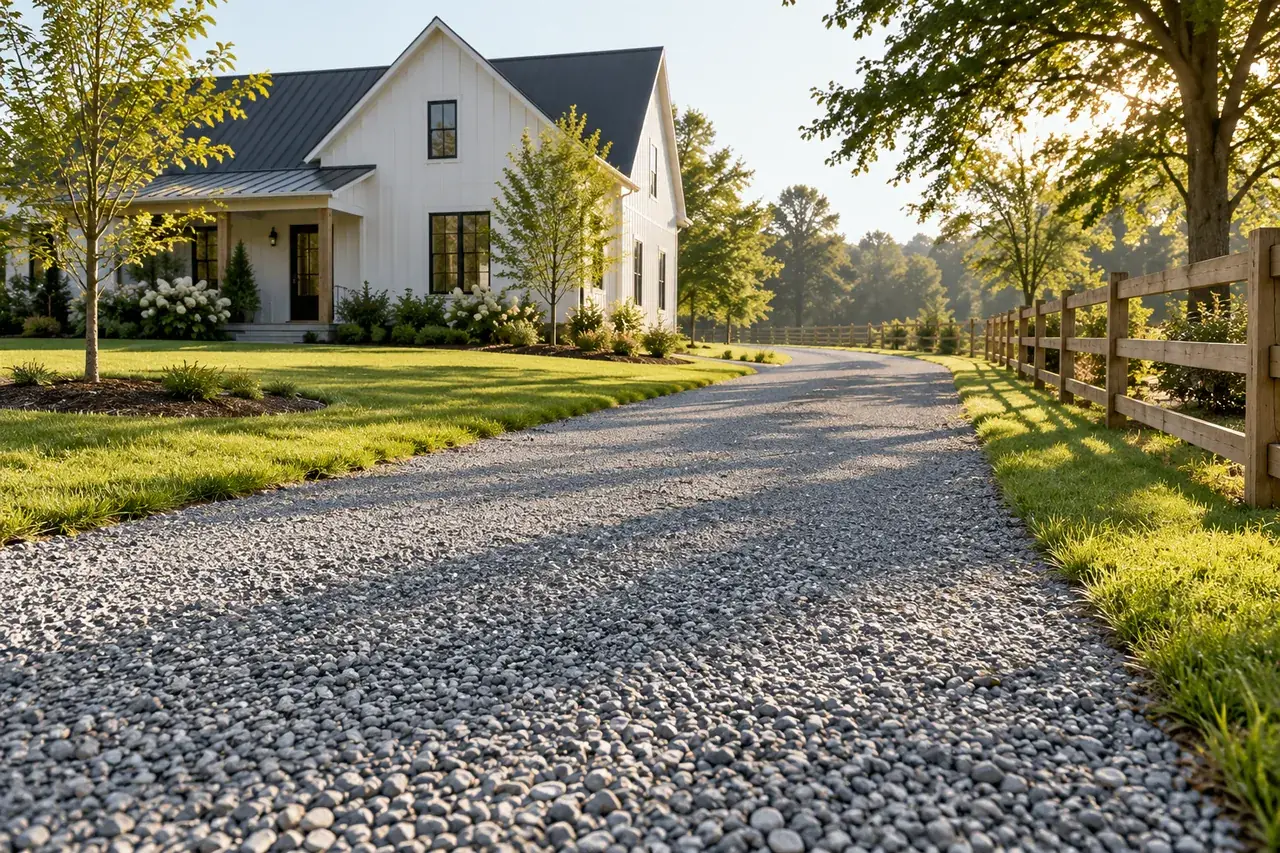
Use this gravel driveway calculator to estimate each material layer from its dimensions and selected depth. Enter the matching supplier density to calculate weight, then add material prices, delivery and other quoted work. Keep the measured requirement, ordering adjustments and final purchasing quantity clearly separated.
This guide explains how to measure a driveway, calculate cubic yards and tons, compare materials and build an itemized budget. It includes a two-layer example, a resurfacing example, drainage considerations and a quote checklist. The calculations support your project specification rather than choosing the construction design for you.
Plan the driveway order
Separate layers · Clear costs · US + metricMeasure. Check. Plan.
Measure your project
Record dimensions and separate layers before estimating.
Use the right basis
Check product specifications, units and supplier quote inclusions.
Keep your project record
Save your inputs and estimate with the print control.
On this page
Start With the Driveway Work You Actually Need
Choose the project scope before entering a depth. Building on an undeveloped site, resurfacing an existing driveway and replacing failed sections involve different quantities and preparation work.
| Project | What to estimate |
|---|---|
| New driveway | Each specified aggregate layer, plus preparation and installation |
| Resurfacing | Additional surface material over a serviceable existing driveway |
| Localized repairs | Separate repair areas and any material needed below the surface |
| Reconstruction | Removal, disposal, base repairs and replacement layers |
New Driveway
List the materials and thicknesses specified for the project. Calculate each layer separately, even when the layers cover the same area.
Include site preparation, drainage work and installation in the budget where required. The aggregate purchase alone does not represent the complete construction cost.
Existing Driveway
Establish what material will remain and whether the supporting layers are serviceable. Estimate only the additional material needed for the agreed work.
Penn State’s Driving Surface Aggregate guidance emphasizes addressing base instability and drainage before placing its surface aggregate. Although that guidance concerns a specific road material, the planning distinction is useful: a new surface layer should not conceal unresolved supporting-layer work.
Choose the work before ordering
New work needs a site-specific base and drainage specification. A top-up adds an identified layer to a sound surface. Repeated ruts, pumping soil or washed-out edges call for a cause assessment before adding more stone.
How to Use the Gravel Driveway Calculator
Work from the project measurements and the supplier’s product information.
- Choose the project scope: new driveway, resurfacing or repairs.
- Enter dimensions or a known area. Include parking pads and turnarounds as separate sections.
- Add each specified layer. Give it a material name and its own depth.
- Enter density if you need tonnage. Match it to the product and volume condition.
- Add any justified ordering adjustment. Keep its purpose visible.
- Enter prices and project charges. Separate material, delivery, preparation, labor and equipment.
The result should show quantities for each material rather than only one combined volume. Different products may need separate orders and deliveries.
Keep the Input Units Visible
Length and width may be measured in feet while layer depth is measured in inches. Convert them before multiplying, or use clearly labeled unit controls.
For supplier quotes, distinguish US short tons from metric tonnes. A cubic yard describes volume and cannot be converted to weight without a density. For a separate loose-stone area outside the driveway scope, use the gravel calculator and keep that order itemized.
Measure the Driveway and Additional Areas
Measure the sections receiving material. Include any specified widening, parking area, entrance apron or turnaround.
Divide irregular layouts into smaller, non-overlapping sections. If one section needs a different thickness, calculate it separately.
Rectangular Sections
For a rectangle:
Area (sq ft) = length (ft) × width (ft)
A driveway measuring 54 feet by 12 feet has an area of 648 square feet.
Tapered Sections
For a straight section that widens consistently from one end to the other:
Area = length × (starting width + ending width) ÷ 2
Use this trapezoid calculation only when the shape fits that description. For curved or uneven boundaries, measure smaller sections instead of assuming a uniform taper.
Parking Pads and Turnarounds
Calculate these areas individually, then add them to the relevant layer estimate. Avoid counting the junction with the main driveway twice.
Keep the same measurement boundaries across drawings, quantity estimates and contractor quotes. Otherwise, two apparently similar quotes may cover different areas.
Check the route, utilities and approvals
Before excavation, use 811’s state-specific safe-digging resources for the required notice and waiting period. Ask the local road authority about an approach or culvert permit and the municipality about drainage and grading requirements. Record private services that may need a separate locate.
This is a role diagram, not a thickness recommendation. Use driveway fabric guidance where separation is part of the design.
Calculate Cubic Yards of Driveway Gravel
For dimensions in feet and layer depth in inches:
Cubic yards = length × width × depth ÷ 324
For an already measured area:
Cubic yards = area (sq ft) × depth (in) ÷ 324
The divisor combines the conversion from inches to feet with 27 cubic feet per cubic yard, as documented in NIST’s measurement tables.
Calculate Every Layer Separately
Apply the formula to each material layer. A base layer and a surface layer may share the same area but have different thicknesses, densities and prices.
Add quantities for an overview, but keep the material breakdown. A combined total is not permission to replace two specified products with one.
Figuring Gravel for Driveway Repairs
Measure the repair footprint and the additional thickness required. Keep deeper repair sections separate from a general surface replenishment.
If material must first be removed, include replacement volume and disposal work in the scope. Do not assume the visible rut depth describes the complete repair.
Understand the Driveway Layers
A driveway specification may identify prepared ground, supporting aggregate layers and a surface layer. The number, thickness and products depend on the site and intended use.
| Part of the project | Information needed |
|---|---|
| Prepared ground or subgrade | Condition, preparation and any required treatment |
| Subbase, where specified | Product, thickness and installation requirements |
| Base layer | Product, grading, thickness and density basis |
| Surface layer | Product, thickness and finished-surface requirements |
This table explains how to organize the estimate. It is not a universal layer design.
Use the Correct Thickness Basis
Confirm whether a stated thickness describes loose placement or the finished compacted layer. Those conditions should not be treated as equivalent without a verified conversion.
Ask the supplier or installer how the specified finished layer translates into an order. Record that conversion separately from any allowance for handling loss.
Avoid a Universal Compaction Percentage
Compaction behavior depends on the aggregate and installation conditions. Penn State’s DSA guidance provides specific loose-to-compacted thickness relationships for that particular material and placement method; those relationships should not be transferred automatically to other products.
Use the conversion that applies to your specified material. An unexplained percentage can make an estimate look precise while changing its meaning.
Worked Example: A Two-Layer Gravel Driveway
Consider a 54-by-12-foot area, totaling 648 square feet. For this calculation example, enter a 4-inch base layer and a 2-inch surface layer.
These depths are illustrative inputs, not a recommended driveway specification. The table shows geometric volumes; any required conversion between finished thickness and loose ordering quantity must be established separately.
| Layer | Calculation | Base volume |
|---|---|---|
| Base | 648 × 4 ÷ 324 | 8 cu yd |
| Surface | 648 × 2 ÷ 324 | 4 cu yd |
| Combined overview | 8 + 4 | 12 cu yd |
The order remains itemized as 8 cubic yards of base material and 4 cubic yards of surface material before adjustments.
Convert Each Layer to Weight
Suppose the calculation uses these illustrative density inputs:
- Base material: 3,000 lb/cu yd.
- Surface material: 2,800 lb/cu yd.
These are example assumptions, not verified specifications for the materials on your project.
| Layer | Volume | Entered density | Estimated weight |
|---|---|---|---|
| Base | 8 cu yd | 3,000 lb/cu yd | 24,000 lb / 12 US short tons |
| Surface | 4 cu yd | 2,800 lb/cu yd | 11,200 lb / 5.6 US short tons |
| Combined overview | 12 cu yd | Different values | 17.6 US short tons |
Using one density for both products would change the estimate. Keep each supplier value attached to its corresponding material.
Show Ordering Allowances Separately
Suppose a chosen 5% allowance applies to the base and 10% to the surface. These percentages demonstrate the calculation and are not standard requirements.
| Layer | Base quantity | Chosen allowance | Adjusted quantity |
|---|---|---|---|
| Base | 8 cu yd | 5% | 8.4 cu yd |
| Surface | 4 cu yd | 10% | 4.4 cu yd |
Confirm the supplier’s available order increments after calculating these quantities. Keep any further rounding visible.
Worked Example: Resurfacing an Existing Driveway
Suppose the same 648-square-foot driveway needs an illustrative 1-inch additional surface layer over a serviceable existing structure.
648 × 1 ÷ 324 = 2 cubic yards
This is a surface-only geometric estimate. It does not include new base layers, localized repairs or a loose-to-finished conversion.
Separate Deeper Repair Areas
If a particular section requires more work, estimate that area independently. Exclude it from the uniform resurfacing calculation where necessary to avoid counting the same material twice.
Record whether the repair requires surface aggregate only or replacement of supporting material as well.
Compare Scope Before Comparing Price
Published price examples: compare the same product and unit
| Location / source | Listed product | USD / sale unit | Extra charges and limits |
|---|---|---|---|
| Dover, ID · Peak Effective February 1, 2026 | 3/4 inch base Type B | $14.50 / ton | Tax excluded; $60 minimum load fee; confirm application |
| Plymouth, ME · B & C 2026 price list; exact effective date not stated | 3/4 inch minus | $13.25 / ton | Tax excluded; $7 scale fee; $25 minimum load charge |
Use your supplier’s current written quote in the calculator. A price per ton cannot be compared directly with a price per cubic yard without a matching bulk density and ton standard. Transport, minimums, tax and installation can change the total substantially.
A resurfacing quote and a reconstruction quote are not interchangeable. One may include only new surface material, while the other includes excavation and base replacement.
Ask both contractors to describe the retained material, repaired areas, new products and installation work.
How Many Tons of Gravel Do I Need?
With supplier density in pounds per cubic yard:
US short tons = cubic yards × density (lb/cu yd) ÷ 2,000
With density in pounds per cubic foot, multiply the cubic-foot volume by that density before dividing by 2,000.
Get Density for the Actual Product
Request bulk density or a supplier-confirmed volume-to-weight conversion. Confirm whether the value applies to loose material, compacted material or another stated condition.
Vulcan Materials’ estimator accepts density in pounds per cubic foot or cubic yard, distinguishes product and geology categories, and recommends local review of project estimates.
Do Not Treat One Yard as One Ton
The units describe different properties. Two products occupying the same volume can have different estimated weights.
If the supplier sells by weight, confirm the purchasing ton standard and how the load quantity will be documented. For a load already quoted in yards or tons, use the cubic yards to tons converter with the actual product density.
Best Gravel for Driveway Use: Compare the Required Job
The best gravel for driveway use is the product that meets the requirements of its assigned layer and site. A decorative appearance does not establish load-bearing suitability.
FHWA’s archived granular-base guidance identifies grading, particle shape, durability and other properties as important to aggregate performance. It favors angular particles for base stability; it does not provide one product recipe for every residential driveway.
Choosing Gravel for Driveway Base and Surface Layers
Ask which product is intended for each layer and what specification it meets. Confirm grading rather than choosing by a familiar trade name alone.
A material selected to provide drainage may behave differently from one selected to form a dense wearing surface.
Open-Graded vs. Well-Graded Aggregate
Penn State’s Aggregate 101 distinguishes open-graded mixtures with substantial spaces between particles from well-graded mixtures containing a broader range of sizes. Its guidance explains their different drainage and compaction roles in road applications.
| Material characteristic | Question to ask |
|---|---|
| Open grading with little fine material | Is this specified for drainage or another particular layer? |
| Broad size distribution | Is the grading suitable for the intended compacted layer? |
| Rounded particles | Will the completed layer provide the required stability? |
| Angular particles | Does the complete product specification match the project? |
Particle shape and grading should be considered together. “Crushed” alone does not establish every required property.
Crushed Stone for Driveways
When purchasing crushed stone for driveways, confirm the exact product, size distribution and intended layer. Ask whether it is clean stone, a graded base product or a specified surface aggregate.
For a crushed stone driveway, keep the supporting and surface products itemized. Products with similar names may still have different specifications.
Pea Gravel Driveway Considerations
A pea gravel driveway needs a project-specific suitability check. Rounded decorative stone should not automatically replace a specified base or surface aggregate.
Consider vehicle use, turning areas, slope, containment and the expected surface behavior. Resolve those requirements before estimating the quantity.
Stone Driveway and Driveway Stone Labels
“Stone driveway” describes a broad type of surface, while “driveway stone” may be a supplier’s sales description. Neither term alone identifies grading, density or installation requirements.
Ask for the exact product name and specification on the quotation and delivery paperwork. Compare clean stone and graded base in the 57 stone and gravel types guide before accepting a substitute.
Driveway Gravel Prices: Compare Matching Units
Driveway gravel prices are useful only when the quoted unit and scope are clear. A price per cubic yard cannot be compared directly with a price per ton without the relevant conversion.
Request the product name, price unit, minimum order, delivery charges and quote validity period.
Material Price per Cubic Yard
Material cost = final ordered cubic yards × price per cubic yard
Use the purchasable order quantity after supplier rounding. Keep the calculated requirement beside it for comparison.
Material Price per US Short Ton
Material cost = final ordered US short tons × price per US short ton
Use the density and quantity basis agreed with the supplier. Do not apply an unrelated online weight-per-yard figure merely to compare prices.
Delivery and Minimum Orders
Ask whether delivery is charged per load, per visit or on another basis. Separate products may require separate deliveries.
Confirm whether a minimum order changes the quantity or total charge. A low material rate can still produce a higher delivered total.
Gravel Driveway Cost: Build an Itemized Budget
Once the layer quantities are checked, use the gravel driveway cost planner to compare itemized materials and delivery with an all-inclusive installed quote on the same scope.
Gravel driveway cost can include material supply, site work and installation. Keep those components separate so you can see what the estimate covers.
| Budget item | Details to confirm |
|---|---|
| Base aggregate | Product, order quantity and unit price |
| Surface aggregate | Product, order quantity and unit price |
| Delivery | Loads, fees and unloading arrangements |
| Preparation | Clearing, excavation, grading and repairs |
| Disposal | Removed material and associated charges |
| Drainage work | Agreed scope and quoted price |
| Installation | Spreading, shaping and compaction |
| Equipment | Included in labor or charged separately |
| Tax and other charges | Included, excluded or not yet quoted |
Avoid counting equipment twice if it is already included in an installation charge.
Worked Budget Example
Using the earlier adjusted quantities, suppose the hypothetical rates are $40/cu yd for base material and $55/cu yd for surface material. For this example, assume the supplier sells those exact quantities.
The following prices demonstrate budgeting arithmetic. They are not current local or national price benchmarks.
| Item | Calculation or allowance | Example cost |
|---|---|---|
| Base material | 8.4 × $40 | $336 |
| Surface material | 4.4 × $55 | $242 |
| Delivery | Assumed combined charge | $150 |
| Preparation | Hypothetical quoted amount | $400 |
| Installation labor | Hypothetical quoted amount | $300 |
| Equipment | Assumed separate charge | $120 |
| Example subtotal | Sum of listed items | $1,548 |
This subtotal excludes tax, disposal and drainage work. Unquoted items should remain identified rather than silently appearing as included.
Material-Only vs. Installed Cost
In this example, material alone costs $578. Material plus the assumed delivery charge costs $728, while the subtotal including the other listed work is $1,548.
Label those totals clearly. Comparing a delivered material quote with a complete installation quote can otherwise create a misleading price difference. If you are considering a paved alternative, use the asphalt calculator to itemize its separately specified layers and work. For a surface-treatment alternative, compare the preparation and quote scope in the tar and chip driveway guide.
Check the contractor before comparing the price
Ask for the business name used on the written quote, the work it will perform and the area it serves. A quote website or directory listing is a starting point; check credentials with the relevant authority and confirm the job directly.
- Identity and credentials: match the quote business to the license or registration record where required. California provides a CSLB license lookup; Washington provides an L&I contractor verification tool. These examples apply to their respective states.
- Service area: confirm your project address is covered and ask about travel, minimum-job and mobilization charges. A city in a listing does not establish a delivery radius.
- Work specification: record material, finished thickness, base preparation, drainage, removal, disposal and who obtains any required approvals.
- Accountability: request insurance information, relevant project references, written payment stages, change-order terms, workmanship terms and a named contact for defects.
- Quote scope: distinguish material supply, delivery, spreading, compaction and a complete installed job. Keep a dated copy and confirm its validity before accepting.
For a bulk order, compare seller terms in the gravel delivery guide. For a recurring failure, use the gravel driveway repair guide to describe the problem before requesting a repair quote.
Drainage: Check Where the Water Will Go
Do not assume a gravel surface eliminates the need to manage runoff. Review the surface shape, adjacent ground and intended drainage outlets as part of the project.
Penn State’s crown and cross-slope bulletin describes different surface profiles used to move water off unpaved roads. The appropriate arrangement depends on the site; a single slope figure should not be applied indiscriminately to every driveway.
Questions for the Site Review
Ask the installer:
- Where will surface water leave the driveway?
- Are there existing low spots or areas of concentrated flow?
- Does the proposed work include drainage improvements?
- Will the finished profile maintain access to garages, gates and adjoining surfaces?
Include agreed drainage work in the quote. Keep it distinguishable from aggregate supply.
Maintenance and Resurfacing Decisions
Inspect the driveway before estimating more material. Record displaced stone, low areas, recurring ruts and places where water collects.
The purpose is to establish the work required. A surface replenishment estimate should not be mistaken for a diagnosis of an underlying problem.
Recurring Ruts or Potholes
If a problem returns after repeated surface filling, request an assessment of the supporting material, drainage and repair scope.
Measure the affected sections separately once the repair method is established. This creates a clearer material order than adding an arbitrary depth to the whole driveway.
Displaced Surface Material
Determine whether existing material can be reused within the agreed work. Calculate new material only for the additional quantity required.
Keep contaminated or unsuitable recovered material out of the estimate unless the installer confirms how it will be handled.
Common Driveway Estimating Mistakes
| Mistake | Better check |
|---|---|
| Using total excavation depth for one product | Itemize the specified layers |
| Treating finished thickness as loose ordering thickness | Confirm the applicable conversion |
| Applying one density to every layer | Use matching product information |
| Measuring the same junction twice | Divide the layout into non-overlapping areas |
| Including all rut depth in a surface-only top-up | Establish the repair scope first |
| Adding compaction and allowance twice | Record the purpose of each adjustment |
| Comparing prices in different units | Normalize quantities using the agreed density |
| Treating material cost as installed cost | Itemize delivery and construction work |
Gravel Driveway Ordering and Quote Checklist
Before purchasing, confirm:
- Scope: new construction, resurfacing, repairs or reconstruction.
- Layout: dimensions, parking areas, entrances and turnarounds.
- Layers: product names and thicknesses for each material.
- Volume basis: loose placement or finished compacted condition.
- Density: supplier values and the units used.
- Adjustments: ordering conversions, allowances and their purposes.
- Purchasing quantities: supplier increments and minimum orders.
- Prices: matching units, delivery, taxes and quote expiry.
- Installation: preparation, shaping, compaction and equipment.
- Additional work: disposal and drainage, where required.
- Delivery access: unloading points and arrangements for moving material.
Keep the measurements and assumptions with the estimate. They help the supplier or contractor review the quantities and clarify the scope.
Frequently Asked Questions
How Deep Should a Gravel Driveway Be?
Use a design appropriate to the site, supporting ground, traffic and selected materials. Confirm the thickness of each layer and whether it describes loose or finished conditions.
The example depths in this guide illustrate calculations. They are not a universal installation recommendation.
Can I Estimate Only the Top Layer?
Yes, when the agreed work is surface replenishment over a serviceable existing driveway. Enter the additional thickness needed rather than the driveway’s full existing depth.
Estimate localized repairs separately where their scope differs.
Can I Use One Aggregate for Every Layer?
Use the products specified for the project. Different layers may have different performance requirements.
Combine an order only when the material and purchasing requirements genuinely match.
Is Clean Stone Always Better Because It Drains?
Drainage and surface stability are different requirements. A clean, open-graded material may suit a particular drainage application without being the specified wearing surface.
Check the role of each layer before selecting the product.
Why Do Driveway Calculators Show Different Tonnages?
Compare their densities, ton standards, thickness assumptions and included allowances. The same geometric volume can produce different weight estimates when those inputs differ.
Use supplier data and keep the assumptions visible.
Can I Use Metric Measurements?
Yes. With dimensions and depth in meters:
Cubic meters = length × width × depth
For example, a 20-meter by 3-meter area with an illustrative 0.05-meter layer has a geometric volume of 3 cubic meters.
Should I Round Every Layer Up to a Whole Cubic Yard?
Use the increments your supplier actually offers. Keep calculations unrounded until the final purchasing decision.
Show the supplier-rounded quantity separately so the extra ordered material remains visible.
How Accurate Is the Estimate?
The calculation reflects the measured area, entered thickness and product assumptions. Irregular ground and uncertain layer conditions can affect the final requirement.
Improve the estimate with separate area measurements, a clear project specification and supplier-confirmed ordering information.
Understand the estimate and its assumptions
Read the formulas and worked examples on this page alongside the entered values. Geometry estimates space; density converts volume to mass; product yield converts a quantity to packages. An allowance and supplier purchase rounding are separate adjustments.
Use the same material condition and units as the supplier specification. Enter a local quoted price when pricing work. Missing fees remain unresolved, and a material subtotal does not establish an installed project price. Example values illustrate arithmetic and are not local quotes or construction specifications.
Keep the printed input record with your estimate so a supplier or contractor can check the values that produced it.