
Choose the material before the quantity
57 Stone, Crushed Stone and Road Base: Choosing the Right Gravel
A driveway base that shifts under tires and a drainage trench that holds water can start with the same mistake: buying stone by its name without checking what the material is designed to do. Products that look similar in a supplier’s yard can behave differently once installed.
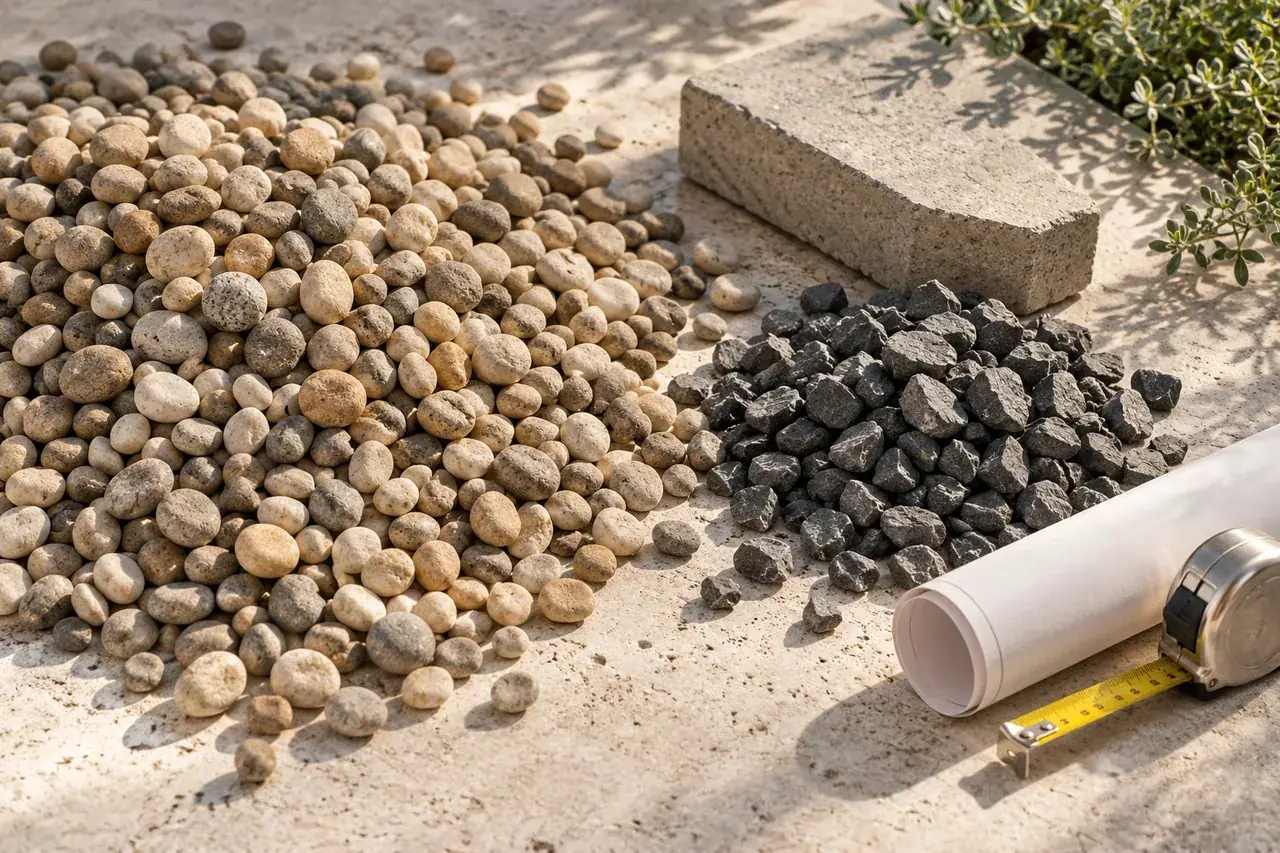
Choosing the right gravel starts with the job each layer must perform. You may need a material that packs into a firm base, an aggregate that leaves space for water, or a surface stone selected for appearance and everyday use.
This guide explains how to compare 57 stone, crushed stone, road base gravel and drainage rock. You’ll learn which product details matter, how to read a grading sheet, and what to confirm before placing an order.
01 / Choose by function
Find the material category to investigate
Tell us what you are building and what the layer must do. Get a clear explanation and a supplier checklist, then compare two material categories below.
Enable JavaScript to use the selector. The page’s static content remains available.
Your entries stay in this page session. Download or copy the brief before leaving. No information is sent to a supplier.
Compare material categories
Select two materials for a side-by-side comparison. These categories do not certify an individual quarry product.
Material guidance follows the distinctions in Penn State’s Aggregate 101 and CMHA’s permeable pavement guide. Obtain the applicable project specification before ordering.
Measure. Check. Plan.
Measure your project
Record dimensions and separate layers before estimating.
Use the right basis
Check product specifications, units and supplier quote inclusions.
Keep your project record
Save your inputs and estimate with the print control.
On this page
Start With the Job, Then Choose the Material
Before comparing colors or prices, finish this sentence:
“This aggregate layer needs to…”
Your answer might be support vehicle loads, carry water around a drain pipe, provide a specified base beneath pavers, or create a decorative surface. Write down that requirement before asking a supplier for recommendations.
Use the following table to organize your conversation. These are starting points for selection, rather than complete installation specifications.
| What the layer needs to do | Material category to investigate | What to verify |
|---|---|---|
| Form a tightly compacted base | Specified dense-graded aggregate | Grading, material quality and compaction requirements |
| Provide open space for drainage | Clean, open-graded aggregate | Permitted sizes, fines limits and drainage-system compatibility |
| Support a permeable pavement system | Aggregates specified for that system | Separate bedding, base and subbase requirements |
| Provide a finished gravel surface | Suitable surface aggregate | Particle shape, grading, comfort and expected traffic |
| Create a decorative landscape finish | Decorative aggregate | Actual appearance, size and suitability for the location |
Supplier catalogs distinguish base aggregates from coarse drainage products, while permeable pavement specifications can require several different aggregate layers. One material name cannot replace those project requirements.
What Are Aggregates?
Aggregates are granular materials used in construction. The category includes products such as crushed rock, gravel and sand.
The term construction aggregate describes a broad material category, rather than one specific product. When requesting a quote, add the material’s intended use and required grade.
For example, “aggregate for my project” leaves important questions unanswered. “Aggregate meeting the specified base-course grading for this parking area” gives the supplier a much clearer starting point. Martin Marietta’s product catalog separates base aggregates from coarse aggregates used in applications such as concrete and drainage.
Crushed Stone, Crushed Rock and Crushed Gravel
Crushed stone and crushed rock commonly describe rock processed into smaller particles. Crushing produces fractured faces, but the final product can contain different combinations of large stones, smaller particles and fines.
Crushed gravel can refer to gravel processed through a crusher. Because suppliers use these terms differently, ask about particle shape and grading rather than assuming the label identifies the finished product.
For granular bases, FHWA identifies particle shape, texture, grading and durability as relevant properties. Angular, rough particles generally provide better interlock than smooth, rounded particles, but shape alone does not establish whether a product meets a base specification.
“Crushed” Does Not Tell You Whether Fines Are Included
Two crushed products may have different purposes:
- A clean product can leave substantial spaces between stones.
- A dense-graded product includes a wider mixture of particle sizes.
- A screenings product contains much smaller material.
Ask the supplier which category you are buying. Penn State distinguishes open-graded aggregates with little or no fines from well-graded mixtures that compact into a denser layer. For rounded decorative material and its order options, use the pea gravel calculator.
What Is 57 Stone?
57 stone, usually written #57 stone, is an aggregate grading designation. It identifies a specified distribution of particle sizes rather than a single exact stone dimension.
The designation also does not tell you the rock’s color or geological source. Those details belong to the particular quarry product.
Penn State explains that AASHTO’s multidigit aggregate designations combine size groups and identifies #57 as an open-graded aggregate. For purchasing, ask which specification the supplier’s product follows.
Are 57 Stone, 57 Gravel and 57 Rock the Same?
You may encounter 57 gravel, 57 rock and #57 crushed stone when searching or comparing local listings. Treat these names as prompts to investigate the product, rather than proof that every listing is interchangeable.
Before choosing between them, request:
- The grading designation and applicable specification.
- The quarry or material source.
- The product’s current grading information.
- Confirmation that it suits the layer you are building.
This helps you compare the actual materials behind the names.
What Size Is #57 Stone?
#57 contains a range of particle sizes. Describing it only as “¾-inch stone” leaves out the grading limits that define the product.
Luck Stone’s technical chart lists #57 using percentages passing different screens. That format is more useful than assuming every particle has one dimension.
If a project calls for #57, request that specified grade. If it calls for another clean aggregate, compare its grading with the required material before accepting a substitution.
Where Can #57 Stone Be Used?
Potential applications include drainage and specified construction layers. Luck Stone includes AASHTO #57 within its permeable coarse-clean category, whose listed applications include French drains, residential drains and concrete slab bedding. Suitability still depends on the individual project specification.
A useful distinction is whether #57 is being selected for a drainage function, a structural layer within a designed system, or an exposed surface. Those uses require different checks.
Does #57 Stone Need Compaction?
Open-graded stone can require compaction even though it does not become a dense, fines-filled mixture.
Compaction helps seat particles and reduce later movement. It does not change #57 into dense-graded road base.
CMHA specifically requires compaction for open-graded aggregates in its guidance on certain residential paver assemblies. Therefore, “clean stone never needs compaction” is an unreliable installation rule. Follow the requirements of the system being built.
When ordering, distinguish between the finished layer thickness and the loose material delivered. Obtain the relevant placement allowance rather than applying one shrinkage percentage to every aggregate.
What Is Road Base Gravel?
For a dense-graded material already selected for the job, use the crusher run calculator with the actual supplier gradation, density and sale unit. Crusher run is not a substitute for specified clean drainage stone.
Road base gravel is sold for supporting road, driveway or pavement layers. Common supplier descriptions include base course, graded base course and aggregate base course.
These labels identify a purpose, but the exact product specification still matters. Martin Marietta describes its base aggregates as materials selected for structural support, load distribution and stability, and notes that specifications vary by facility and application.
Is Road Base the Same as Crusher Run?
Some suppliers use names such as crusher run, dense grade and road base for overlapping product categories. Do not assume they all represent an identical grading.
Ask for the named grade behind the sales description. A regional DOT designation or a supplier grading sheet gives you something concrete to compare.
Luck Stone’s grading chart lists separate products such as #57, 21A and 21B. It also notes that its base grading information is a guide and individual plants have distinct job mixes.
Why Do Smaller Particles Matter in a Base?
Grading affects both stability and permeability. A base specification controls the distribution of particle sizes because the balance matters to performance.
FHWA’s granular-base guidance discusses grading and fines alongside particle shape and durability. Adding arbitrary dust to a clean stone product is not equivalent to buying an aggregate that meets a specified base grading.
For purchasing, ask: “Does this product meet the base specification for my project?” That is more useful than asking only whether it “packs hard.” For a driveway order with separate supporting and surface layers, use the gravel driveway guide.
What Are Drain Rock and Drainage Gravel?
Once the clean-stone and pipe assembly is specified, the French drain installation cost planner accounts for pipe displacement, wrapped fabric and itemized supply costs.
Drain rock and drainage gravel describe materials sold for drainage applications. These names do not establish one nationwide size or grading.
Start with the drainage system’s requirements, then compare available products. A supplier’s drainage category can include several grades: Luck Stone’s coarse-clean range, for example, lists #357, #56, #57, #68 and #5.
Does “Clean” Mean the Product Meets Your Specification?
Ask what the supplier means by clean or washed. Then request the grading and any required test documentation.
A product description is useful, but a grading report provides measurable information. Do not replace a specified fines limit with a visual judgment that a stockpile “looks clean.”
Drainage Stone Is One Part of the System
Before buying, identify how the complete system will handle water:
- Where will water enter?
- Where will it leave or infiltrate?
- What keeps surrounding soil from entering the aggregate?
- Which pipe, filter and aggregate details are required?
For example, CMHA’s permeable pavement specification distinguishes infiltration into suitable subgrade from systems that need underdrains to discharge water. Aggregate selection must fit that drainage arrangement.
Clean Stone vs. Dense-Graded Aggregate
The important difference is the mixture of particle sizes.
Open-graded aggregate leaves more void space. Well-graded aggregate includes a broader size distribution and forms a denser mixture when compacted. Penn State identifies the former with drainage applications and the latter with compactable road surface applications.
For your project, turn that distinction into two questions:
Does this layer need to pass water through its aggregate structure?
Does this layer need to meet a specified dense-base grading?
If both requirements appear in the project, check whether they belong to separate layers or an engineered pavement system. Avoid selecting a compromise material without confirming the design.
Can Clean Stone Be Used as a Structural Base?
Yes, in systems designed for it.
CMHA’s permeable interlocking concrete pavement guide describes an open-graded assembly with distinct bedding, base and subbase materials. #57 is typically identified for the base within that assembly.
That does not make #57 a universal replacement for another specified base. The surrounding layers, drainage arrangement and project design are part of the selection.
This is why simple advice such as “always use road base” or “always use clean stone” can miss important project differences.
How to Read an Aggregate Grading Sheet
A grading sheet shows how much material passes through specified sieve openings.
Percent passing is cumulative. A value of 60% passing a particular sieve means 60% of the sample by weight passes that opening. It does not mean 60% of the stones are exactly that size.
Supplier charts use this format to compare multiple aggregate grades. Luck Stone’s chart, for example, identifies its data as weight percentages passing screens.
Check These Five Details
When reviewing a document, look for:
- Product identity: Does it match the quoted material?
- Specification: Which grading requirements apply?
- Document type: Is it a specification range or a tested sample?
- Source and date: Which plant and production information does it represent?
- Compliance: Does the supplied product meet the project’s requirements?
A general product chart and a current test report serve different purposes. Ask which one you need before approving an order.
Three Material-Selection Examples
Planning a shed foundation? Use the gravel shed pad planner only after checking the shed maker’s required stone and foundation assembly.
These examples show how to organize a decision. They are not construction designs.
Example 1: Choosing Aggregate Around a Drain Pipe
Suppose the drainage instructions specify a particular clean aggregate.
Compare products against that requirement first. Ask the supplier for grading information and confirm compatibility with the specified pipe and filter arrangement.
A cheaper product sold as “driveway gravel” should not be accepted solely because its largest stones look similar. Your decision should follow the drain’s material requirements.
Example 2: Choosing a Compacted Base
Suppose a parking-area design specifies a dense-graded aggregate base.
Request a product that meets that specification. Compare the quote, grading information and installation requirements before calculating the purchase quantity.
If the supplier offers clean #57 instead, ask for the technical basis for that substitution. A change in material can require a change in the assembly.
Example 3: Comparing Two “Road Base” Quotes
Suppose two suppliers both quote “road base.”
Create a comparison with separate fields for grade, quarry source, specification status, selling unit, delivery charge and required placement allowance. Leave unknown fields blank until the suppliers answer.
This prevents a lower headline price from deciding the purchase before you know whether the products are comparable. If the project is a seating area, review the pea gravel patio guide for furniture, access, and border decisions.
What to Ask Your Gravel Supplier
Use this checklist before placing an order.
| Question | Information you need |
|---|---|
| What is the exact product and grade? | A specific material identity |
| Which specification does it meet? | A basis for checking suitability |
| Can you provide grading information? | Particle-size distribution |
| Is this a general chart or current test report? | The document’s purpose |
| Which quarry or plant supplies it? | The source of the quoted product |
| Is the price per US ton or cubic yard? | A clear purchasing unit |
| What weight conversion applies to this product? | A product-specific quantity estimate |
| Is the planned depth loose or finished? | A consistent basis for ordering |
| What placement allowance applies? | An explained adjustment |
| What is included in delivery? | A comparable delivered quote |
Record the answers with the quote. If the delivered material or source changes, review the information again before accepting the substitution.
How Much Material Should You Order?
Choose the material and establish the layer dimensions before calculating quantity.
For each layer, record its area, intended finished thickness, purchasing unit and any justified delivery allowance. Keep different materials separate in the estimate.
If purchasing by weight, obtain the conversion for the actual product. Supplier product specifications themselves describe their outputs as estimates and direct buyers to confirm project-specific requirements with a local representative.
Use the site’s gravel calculator for the quantity calculation once those inputs are known. This guide answers the earlier question: which aggregate belongs in the project? After selecting the specified material, use the gravel calculator with its measured layer depth and supplier data.
Comparing Gravel Costs Fairly
Published price examples: compare the same product and unit
| Location / source | Listed product | USD / sale unit | Extra charges and limits |
|---|---|---|---|
| Mansfield, OH · Petty Farms Effective January 1, 2026 | #57 limestone | $33.00 / ton | 7% seller-listed tax unless exempt; delivery not established |
Use your supplier’s current written quote in the calculator. A price per ton cannot be compared directly with a price per cubic yard without a matching bulk density and ton standard. Transport, minimums, tax and installation can change the total substantially.
Request quotes for the same required material and delivered quantity.
Compare the complete purchase, including delivery, minimum loads and any charges that affect your order. If suppliers quote different units, establish a consistent conversion before comparing totals.
Keep the material specification visible beside the price. A quote for an unspecified blend and a quote for a documented grade should not be treated as equivalent without checking the details.
Before You Place the Order
Write down the layer’s purpose, required grade, source, finished thickness and purchasing unit. Then check that the supplier’s quote describes that same material.
Those details give you a practical basis for choosing between 57 stone, crushed rock, road base and drainage gravel—and for estimating the quantity after the selection is settled.
Check the delivered product before placement
Match the product name and source on the delivery ticket to your written order. Check the scale ticket or billed volume, the visible stone/fines, contamination and the promised product documentation. Photograph a discrepancy and contact the seller before spreading. Keep the ticket with your gravel quantity estimate.
| Material description | Question that resolves the purchase |
|---|---|
| #57 stone | Which grading specification and source does this product meet? A marketing size name alone is insufficient. |
| #8 stone | Is it a washed smaller stone or another locally named material? Get the exact product sheet. |
| Crusher run / dense-graded base | Which grading, fines and compaction specification is required for this layer? |
The delivery guide’s named price examples include a seller-listed #57 limestone price; it does not certify a product’s gradation or suitability.
Frequently Asked Questions
Is 57 Stone the Same as ¾-Inch Gravel?
Do not assume so. #57 is a grading designation containing a range of particle sizes; “¾-inch gravel” may be a supplier’s descriptive label.
Request the grading information for both products before treating them as interchangeable.
Is Crushed Stone Better Than Rounded Gravel?
It depends on the intended use. For granular-base stability, FHWA generally favors angular, rough particles over smooth, rounded particles.
For a decorative purchase, appearance and the project’s surface requirements also matter.
Can Road Base Gravel Replace Drain Rock?
Only if it meets the drainage system’s requirements. A road-base sales label does not demonstrate the required grading or permeability.
Compare specifications before substituting one product for another.
Can #57 Stone Be Used Beneath Pavers?
Yes, where the pavement assembly specifies it. CMHA’s permeable pavement guide includes #57 as a typical base material.
Follow the complete system’s requirements for bedding, base, subbase and drainage.
How Deep Should the Aggregate Layer Be?
Depth depends on the project and site conditions. CMHA’s pavement guidance identifies soil strength, drainage, climate and traffic loads as relevant design factors.
Use the required depth for your assembly rather than transferring a depth from an unrelated gravel project.
Do All Gravel Projects Need Landscape Fabric?
Do not choose fabric from the gravel name alone. Establish whether the project requires separation, filtration or another function.
CMHA distinguishes geotextile selection from aggregate selection and refers to specified geotextile requirements for applicable pavement projects.
What If the Supplier Cannot Provide Product Information?
Ask whether it offers a documented alternative that meets your requirements.
For work governed by a material specification, resolve missing information before ordering. For a decorative purchase, inspect an actual sample and clarify what will be delivered.
Understand the estimate and its assumptions
Read the formulas and worked examples on this page alongside the entered values. Geometry estimates space; density converts volume to mass; product yield converts a quantity to packages. An allowance and supplier purchase rounding are separate adjustments.
Use the same material condition and units as the supplier specification. Enter a local quoted price when pricing work. Missing fees remain unresolved, and a material subtotal does not establish an installed project price. Example values illustrate arithmetic and are not local quotes or construction specifications.
Keep the printed input record with your estimate so a supplier or contractor can check the values that produced it.