
Paver Base Calculator:
Plan every layer.
Running short of base gravel can stop a paver project, even when the paver count is right.
This paver calculator separates pavers, aggregate, bedding and joint sand into clear material orders.
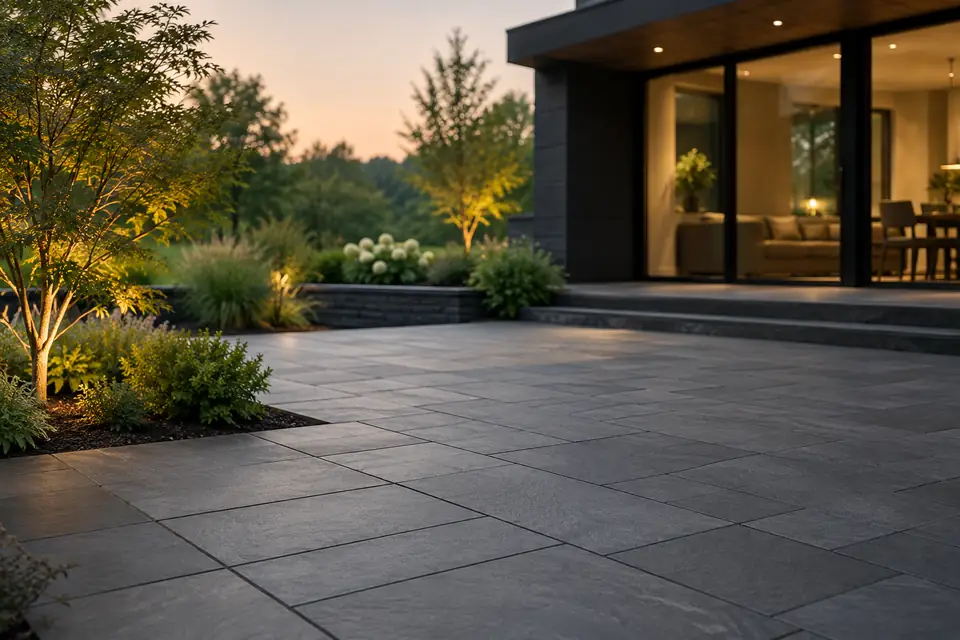
Choose full-project or base-only planning, use US or metric measurements, and price the actual purchases.
Build your material order
Measure the footprint, choose the coverage and keep every allowance visible.
Measure. Check. Plan.
Measure your project
Record dimensions and separate layers before estimating.
Use the right basis
Check product specifications, units and supplier quote inclusions.
Keep your project record
Save your inputs and estimate with the print control.
A clear order begins with clear assumptions.
Follow the measurement, coverage and purchasing steps below.
On this page
Why paver orders need separate quantities
A patio can have enough pavers and still run short of base material. The gravel footprint may extend beyond the paving, the specified depth may refer to compacted material, and a bag of joint sand can cover very different areas depending on the joints.
This paver base calculator guide separates the quantities you need: pavers, stone base, bedding sand and joint sand. Start with measured areas and project specifications, then turn each result into an order using the supplier’s coverage, package sizes and prices.
Choose the estimate that matches your project
A full-project paver calculator needs the paved area, the chosen paver’s installed coverage, its layout and cut allowance. It also needs the footprint and depth of each underlying layer. A base-only estimate uses the layer measurements without asking you to select a paver size.
Keep both estimates on the same project worksheet. When a supplier changes the package size or your installer changes a layer depth, revise the affected line rather than rebuilding the entire order. Record the original quantity, the allowance and the rounded purchase quantity separately.
Measure the paved area and each layer footprint
The calculator also accepts circles, triangles with a measured perimeter, and an outside rectangle minus one rectangular corner notch. For a 20 × 15 ft outline with an 8 × 5 ft corner removed, area is 260 sq ft and outer perimeter is 70 ft. The notch replaces two outside runs with equal-length inside runs; shared rectangle edges are not added. Deduct any other excluded openings once.
For a rectangle, multiply length by width. Measure in one unit system, then subtract openings that are genuinely outside the paving. A planter, tree opening or existing slab may reduce the paver area; a drain cover surrounded by cut pavers may require a more careful layout allowance.
Net paved area = gross paved area − excluded openings
For an L-shaped patio, divide the outline into rectangles that do not overlap. Add their areas, then subtract openings once. A circular area uses π × radius². For a curved boundary, use a scaled plan or measured area rather than treating its enclosing rectangle as the finished surface.
Create three area entries: paved surface, aggregate base and bedding layer. They can be equal, but should not be forced to match. A base extending outside an edge restraint has more area than the pavers above it. An opening may exclude every layer, or just the surface, depending on the detail.
For example, a 20 × 12 ft paved rectangle has 240 sq ft. Removing a 4 × 6 ft planter leaves 216 sq ft of paving. If the confirmed base outline is 21 × 13 ft and the same planter is excluded from that layer, the base area is 249 sq ft. The 6-inch extension on each side is an illustrative project input, not a universal edge detail.
Write dimensions on a sketch with fixed reference points. Identify walls, steps, curves, border strips and drains. This makes it easier to catch a duplicated opening or a border counted twice before you buy material.
Calculate paver counts using installed coverage
The most useful count starts with the manufacturer’s coverage for the actual product. A nominal size, physical face dimension and installed module are not always interchangeable. A module represents the repeating space occupied by a unit in the specified layout, including the applicable joint convention.
Use published pieces per square foot or square feet per bundle when available. Manufacturer resources such as Belgard’s product and pattern guides help you identify the intended product information. Confirm regional availability, packaging and coverage with the dealer supplying your order.
Pavers before allowance = net paved area × pieces per square foot
If the product is a single rectangular module, its coverage in square feet is module length in inches × module width in inches ÷ 144. Divide the project area by that coverage. Keep full precision through the calculation and round only the final purchase quantities.
A hypothetical 6 × 9 inch installed module covers 54 ÷ 144 = 0.375 sq ft. For 216 sq ft, the theoretical count is 216 ÷ 0.375 = 576 units. Do not add another joint width if the supplied dimensions already describe installed coverage.
For a custom physical-dimension estimate, establish how joints are included in the repeated module before calculating coverage. A simple rectangular grid can use length plus one repeating joint and width plus one repeating joint, but edge conditions and the selected layout still need checking. Published installed coverage usually avoids this ambiguity.
Multi-size patterns, bundles and borders
Enable the optional repeating-module breakdown under mixed-size bundle coverage when the actual pattern gives both installed coverage and whole counts of each named size. For the hypothetical 216 sq ft area, a 3 sq ft module and a separate selected 5% module allowance require 76 whole modules: 152 large and 304 small pieces for the two-large/four-small mix. This supplemental list does not replace the dealer’s bundle order or add a second paver cost.
A three-size blend needs its prescribed ratio, not an average paver size. If a complete repeating module covers 3 sq ft and contains two large and four small pieces, 216 sq ft represents 72 repeats: 144 large and 288 small pieces before allowance. That is an original arithmetic example, not a manufacturer pattern.
When a product is sold as a mixed bundle, use bundle coverage and preserve its mix. If a border uses a different product, estimate its run from the layout, deduct its area from the field paving where appropriate, and price it separately. Never count a border as both field pavers and additional paving.
Apply a cut allowance, then supplier rounding
A cut allowance covers the units that your layout may consume beyond the theoretical surface count. Curves, narrow strips, diagonal boundaries, borders and the ability to reuse cut pieces all affect the order. The pattern name alone does not establish a reliable percentage.
Paver order before pack rounding = round up [theoretical count × (1 + allowance)]
For the 576-unit example, a selected 5% allowance gives 604.8, rounded to 605 units. A selected 10% allowance gives 633.6, rounded to 634. These percentages illustrate two purchasing scenarios; they are not recommended defaults for every straight or diagonal layout.
| Planning scenario | Stated allowance | Order before packs |
|---|---|---|
| Layout A: fewer boundary cuts | 5%, selected for this example | 605 units |
| Layout B: more boundary cuts | 10%, selected for comparison | 634 units |
Package rounding is a second step. If the dealer sells individual units, 605 may be orderable. If a hypothetical product is sold only in packs of 120 units, the same requirement becomes six packs, or 720 units. Show that excess explicitly so the buyer can ask about split packs, returns or spare storage.
Extra purchased pavers do not increase the installed area. Do not apply paver cut allowance to gravel, bedding sand or joint sand. Each material gets its own justified adjustment.
Estimate gravel base from the specified footprint and depth
For a separate dense-graded base order outside this paver project, use the crusher run calculator after confirming that exact product is specified. Keep this paver assembly’s base order in the layer calculator above.
Depth must come from the selected project design, intended loading and site conditions. The CMHA construction technical note describes the aggregate-base, bedding-sand and paver assembly and discusses soil, traffic and environmental factors. A patio’s square footage alone cannot determine its base thickness.
Layer volume in cubic yards = area in square feet × depth in inches ÷ 324
The divisor combines 12 inches per foot and 27 cubic feet per cubic yard. In metric units, multiply area in square meters by depth in meters. For a depth entered in millimeters, divide it by 1,000 first.
If the design says 4 inches compacted, the calculated volume describes that compacted layer. A supplier’s loose delivery quantity may require a separate conversion. Ask what the quoted yard or ton represents and what order factor applies to the specified aggregate.
For 249 sq ft at a selected 4-inch compacted depth, the geometric volume is 249 × 4 ÷ 324 = 3.0741 cubic yards. An illustrative supplier factor of 1.20 produces 3.6889 loose cubic yards. If orders are rounded up in quarter-yard increments, the purchase quantity is 3.75 cubic yards.
Extra volume and shrinkage are different inputs
Adding 20% to a calculated quantity means multiplying by 1.20. If a verified assumption instead says loose volume reduces by 20% of its starting volume, the conversion is 1 ÷ 0.80 = 1.25. These statements produce different results.
Record the supplier’s factor and its meaning. Do not apply both conversions to the same adjustment. If a quoted order already includes handling allowance, adding another blanket percentage can also count that allowance twice.
For a quote in US short tons, multiply the relevant volume by a matching supplier density in short tons per cubic yard. Confirm whether the density describes loose delivered material or compacted material. For another bulk aggregate order, the gravel calculator helps organize volume and supplier density without tying the estimate to a paver layout.
Choose the base system before the shopping list
The optional restraint worksheet uses the measured boundary that actually needs restraint, usable piece length, whole pack size and the fastening count from the chosen product detail. At an illustrative 70 ft run, 8 ft pieces, four pieces per pack and zero extra allowance, nine required pieces become three packs containing 12 pieces. Fasteners need their own confirmed count; area does not establish spike spacing.
The main calculator estimates conventional aggregate base, bedding and pavers. A manufactured panel system has a different approved assembly. The manufacturer’s 6 ft² panel guide applies to that specific panel format; confirm the exact product, load use and installation instructions before substituting a panel system for a specified aggregate base.
List excavation, disposal, restraint length, stakes, drainage, cuts, handling and delivery alongside the pavers. Concrete, clay, natural stone and porcelain prices need the same sale unit and installed system before comparison. Count edging along the actual outside and internal openings; do not infer it from area alone.
Calculate bedding sand as its own layer
For the conventional system addressed in the CMHA note, bedding sand is screeded to a nominal 1-inch uncompacted thickness, and it should not be used to correct an uneven base. Follow the bedding material and screeding guidance for that system and the specifications for your chosen installation.
At 216 sq ft and an example 1-inch uncompacted depth, sand volume is 216 ÷ 324 = 0.6667 cubic yards, or 18 cubic feet. An independently selected 5% handling allowance gives 0.7000 cubic yards, or 18.9 cubic feet.
If the supplier sells bulk sand in quarter-yard increments, order 0.75 cubic yards. If a compatible bagged product yields 0.5 cubic feet per bag, the same adjusted requirement needs 38 bags. The bulk and bag orders contain slightly different volumes because each purchase method rounds separately.
Bag weight alone is insufficient for a volume-based layer unless a suitable density is provided. Read the package yield and verify material compatibility. Use the sand calculator for a separate bulk-versus-bag estimate once the bedding product and depth are confirmed.
Estimate joint sand using the actual product’s coverage
Bedding volume does not tell you how many bags of joint sand to buy. Match product coverage to the paver geometry, joint width, joint depth, color and installation system. Use installed paving area, rather than the area represented by spare pavers.
For a documented example, Alliance Gator’s US Gator Maxx G2 coverage lists the following ranges per 50-lb bag for Beige, Slate Grey and Ivory with 2⅜-inch-high pavers:
| Manufacturer’s joint category | Published coverage per bag |
|---|---|
| Narrow: ⅛–⅜ inch | 65–85 sq ft |
| Wide: ¾–1¼ inch | 22–42 sq ft |
These are product-specific ranges. The technical sheet, marked updated May 6, 2025, identifies geometry-dependent coverage and different figures for Black Diamond. Confirm compatibility and the applicable current instructions before ordering.
Bags = round up [installed area × (1 + joint-material allowance) ÷ coverage per bag]
For the matching narrow-joint example at 216 sq ft, the published coverage range produces three to four bags before an extra allowance. Using its lower coverage end for this planning scenario gives four bags. That does not guarantee four bags for every 216 sq ft layout.
Worked example: a complete patio material order
This original example brings the calculations together. It assumes a conventional specified assembly, a 216 sq ft paved area, a 249 sq ft base footprint and a 6 × 9 inch installed paver module. The opening is excluded from every layer in this example. All allowances and purchase increments below are illustrative inputs, not construction recommendations.
| Material | Calculation basis | Purchase quantity |
|---|---|---|
| Pavers | 576 theoretical units × 1.05; dealer permits individual-unit orders | 605 units |
| Aggregate base | 249 sq ft × 4 in ÷ 324 × 1.20; quarter-yard increments | 3.75 cubic yards loose |
| Bedding sand | 216 sq ft × 1 in ÷ 324 × 1.05; quarter-yard increments | 0.75 cubic yards |
| Joint sand | 216 sq ft ÷ 65 sq ft/bag; matching example product conditions | 4 bags, 50 lb each |
The important distinction is the path from measurement to purchase. The base begins with a larger footprint. Its volume adjustment is independent of the paver allowance. Bedding gets its own handling allowance, and joint sand uses manufacturer coverage. None of those steps depends on how many spare pavers are bought.
Price the actual order, then identify missing costs
Published price examples: compare the same product and unit
| Location / source | Listed product | USD / sale unit | Extra charges and limits |
|---|---|---|---|
| Bulverde, TX · Blanco Road Mulch 2026 price list; exact effective date not stated | 3/4 inch to dust base | $50.00 / yard | Tax and destination freight not resolved |
| Dover, ID · Peak Effective February 1, 2026 | Washed concrete sand ASTM C33 | $25.00 / ton | Tax and haul additional |
These base and sand products are not automatically approved for your paver system. Match the project’s specified gradation and condition before entering a price. Pavers, jointing sand, edging, fabric, compaction equipment, delivery and installation are separate quote items.
Multiply purchase quantities by matching quoted rates. A per-unit paver quote uses the purchased count; a per-pallet quote uses pallet count. A per-ton aggregate quote requires a tonnage estimate on the supplier’s stated basis. Record quote date, location, delivery conditions and whether tax is included.
The prices below are invented solely to demonstrate arithmetic. They are not live US averages, local quotes or market benchmarks.
| Line item | Hypothetical rate | Example cost |
|---|---|---|
| 605 pavers | $1.25 each | $756.25 |
| 3.75 cubic yards base | $55 per cubic yard | $206.25 |
| 0.75 cubic yards bedding sand | $65 per cubic yard | $48.75 |
| 4 joint-sand bags | $38 per bag | $152.00 |
| Listed materials subtotal | Four lines above | $1,163.25 |
| Delivery | Assumed separate charge | $140.00 |
| Known supply subtotal | Materials plus delivery | $1,303.25 |
That subtotal excludes edging, excavation, disposal, equipment, installation labor, tax and any project-specific drainage or separation materials. Include applicable items as separate quote lines. An empty price field means unpriced, rather than a confirmed zero-dollar cost.
If you are still choosing the surface rather than placing an order, compare the different project workflow in the pea gravel patio guide. A loose gravel patio and an interlocking paver assembly should not share an assumed bill of materials.
Check the contractor before comparing the price
Ask for the business name used on the written quote, the work it will perform and the area it serves. A quote website or directory listing is a starting point; check credentials with the relevant authority and confirm the job directly.
- Identity and credentials: match the quote business to the license or registration record where required. California provides a CSLB license lookup; Washington provides an L&I contractor verification tool. These examples apply to their respective states.
- Service area: confirm your project address is covered and ask about travel, minimum-job and mobilization charges. A city in a listing does not establish a delivery radius.
- Work specification: record material, finished thickness, base preparation, drainage, removal, disposal and who obtains any required approvals.
- Accountability: request insurance information, relevant project references, written payment stages, change-order terms, workmanship terms and a named contact for defects.
- Quote scope: distinguish material supply, delivery, spreading, compaction and a complete installed job. Keep a dated copy and confirm its validity before accepting.
For a bulk order, compare seller terms in the gravel delivery guide. For a recurring failure, use the gravel driveway repair guide to describe the problem before requesting a repair quote.
Base-only example: order materials before selecting pavers
Suppose the confirmed aggregate footprint is 200 sq ft and the project specifies 4 inches compacted. Its geometric volume is 200 × 4 ÷ 324 = 2.4691 cubic yards. An illustrative supplier order factor of 1.10 gives 2.7160 cubic yards; quarter-yard purchase increments produce a 2.75 cubic yard order.
If a separate 200 sq ft bedding footprint uses a specified 1-inch uncompacted layer, its unadjusted volume is 0.6173 cubic yards. Do not silently apply the aggregate factor to sand. Add a separate justified sand allowance and round to the sand supplier’s purchase increment.
This estimate can be useful while product selection is pending. Mark paver counts, joint-sand bags and their costs as pending rather than showing a complete-project total.
Printable paver order checklist
- Project geometry: paved area, openings, border areas and a dimensioned sketch.
- Layer footprints: confirmed base and bedding areas, including the treatment of openings and edge extensions.
- Paver product: product name, installed coverage, pattern mix, thickness, color and dealer packaging.
- Paver order: theoretical count, chosen cut allowance, pack rounding and resulting spare quantity.
- Base order: specified material and compacted depth, geometric volume, supplier conversion and delivery unit.
- Bedding order: specified product, depth and depth state, independent allowance and package yield.
- Joint material: compatible product, joint geometry, applicable coverage range and whole-bag quantity.
- Remaining materials: required edge restraints and any design-specified drainage or separation items.
- Commercial details: dated local quotes, delivery access, tax, minimum order, returns and split-pack availability.
- Final review: installer and supplier agree on the specifications, quantities and meaning of every allowance.
Common questions about paver quantities
How many pavers do I need?
Divide net paved area by installed coverage per unit, or multiply it by the manufacturer’s pieces per square foot. Apply the chosen cut allowance, then round to whole units and supplier packs. Mixed-size products need their bundle coverage or specified piece ratio.
How much gravel base do I need?
Multiply the base footprint by its specified depth. Convert to the supplier’s unit, then apply a verified order conversion if the calculated layer and delivery quantity describe different material states. Keep the compacted design quantity visible alongside the delivery order.
Can I use the same area for every material?
Yes, if the confirmed installation detail makes the footprints equal. Otherwise use separate areas. A larger base outline does not create more installed pavers, and spare pavers do not create more joint area.
Should I always add the same waste percentage?
No single percentage explains paver cuts, aggregate volume conversion and bedding handling. Name each adjustment, apply it only to its material and check whether the supplier’s quote already includes it.
What if joint-sand coverage is a range?
Calculate whole-bag quantities at both ends and keep the product conditions visible. Confirm the appropriate planning basis with the supplier or manufacturer; the middle of a range is not a verified yield for your layout.
Does this estimate include excavation?
No. Excavation needs its own footprint, finished elevations and layer states, followed by disposal planning. Do not simply add an uncompacted bedding depth to compacted layer depths and label the sum a finished excavation specification.
What makes an estimate ready to order?
The geometry is checked, the assembly is specified, product coverage matches the actual pavers, delivery quantities use the supplier’s basis, and unpriced items remain visible. A useful result is a traceable order with assumptions the installer and dealer can review.
Understand the estimate and its assumptions
Read the formulas and worked examples on this page alongside the entered values. Geometry estimates space; density converts volume to mass; product yield converts a quantity to packages. An allowance and supplier purchase rounding are separate adjustments.
Use the same material condition and units as the supplier specification. Enter a local quoted price when pricing work. Missing fees remain unresolved, and a material subtotal does not establish an installed project price. Example values illustrate arithmetic and are not local quotes or construction specifications.
Keep the printed input record with your estimate so a supplier or contractor can check the values that produced it.